Sunscreen is the only product in your routine that is doing two jobs at once: it is preventing the photoaging everyone gets, and it is preventing the post-inflammatory hyperpigmentation that everyone with melanin gets faster, longer, and more visibly. Skip it for a week and you can watch a healed pimple turn into a six-month dark mark. The 2024 international consensus of dermatologists treating Fitzpatrick IV to VI skin made the point bluntly: high-factor broad-spectrum sunscreen is non-negotiable, full stop.
The problem is that most of the sunscreens marketed to acne-prone skin in the United States were not formulated with darker complexions in mind, and most of the sunscreens that look beautiful on brown skin were not formulated with breakout-prone skin in mind. The category is full of compromises. After pulling the dermatology research and stress-testing what is actually on the shelves in 2026, five formulas land in the small overlap between non-comedogenic, brown-skin-friendly, and elegant enough to wear daily.
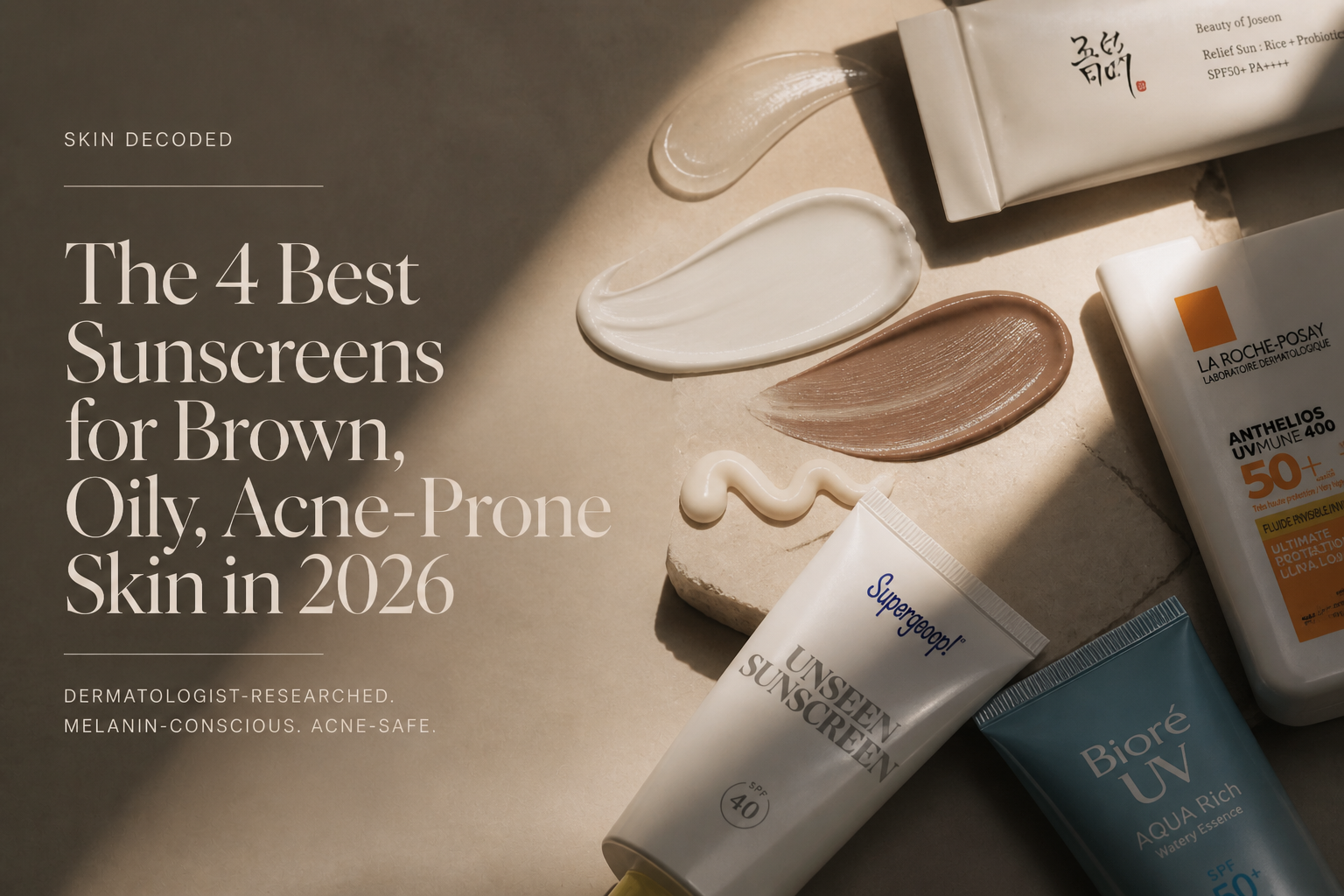
TL;DR: Properly formulated sunscreens lower acne lesion counts and prevent the post inflammatory pigmentation that makes brown skin look uneven for months. The five that actually work for oily, melanin-rich, breakout-prone skin in 2026 are La Roche-Posay Mela B3 UV Daily Moisturizer SPF 30 (my personal everyday pick for dark-spot prevention), Beauty of Joseon Relief Sun, La Roche-Posay Anthelios UV Mune 400, Supergoop Unseen Sunscreen, and Biore UV Aqua Rich Watery Essence.
Why Brown, Oily, Acne-Prone Skin Is Its Own Category
Three things are happening on this skin that generic SPF advice never quite addresses.
The melanin makes inflammation cost more. When acne-prone melanin-rich skin gets a breakout, the post-inflammatory hyperpigmentation that follows can outlast the pimple by six to twelve months. UV exposure deepens that pigment and slows its fade. The 2023 exposome review by Piquero-Casals and colleagues laid out the cycle directly: sun exposure can briefly mask acne but worsens long-term inflammatory and pigmentary outcomes, and consistent photoprotection lowers both inflammatory and non-inflammatory lesion counts.
The oil makes texture matter more. The heavy, draggy, white-cast mineral sunscreen an esthetician might recommend to a redhead with rosacea is exactly the wrong choice on oily T-zones. It pills, it slides, it traps sebum. Texture is not a vanity issue here. It is the reason people skip sunscreen entirely.
The visible light problem is real for us specifically. Standard broad-spectrum SPF protects against UVB and most of the UVA range, but it does not block the visible light that drives melasma and pigmentary darkening on Fitzpatrick III to VI skin. The Lyons 2021 review in JAAD established that tinted sunscreens with iron oxides are currently the only consumer-accessible way to filter visible light. If your dark spots have a hormonal driver, this changes which sunscreen you should buy.
Top Picks at a Glance
| Product | Best for | Key actives | Price tier |
|---|---|---|---|
| La Roche-Posay Mela B3 UV Daily Moisturizer SPF 30 (editor's pick) | Daily moisturizer-plus-SPF for dark spots and uneven tone | Melasyl, niacinamide, hyaluronic acid, broad-spectrum filters | Mid |
| Beauty of Joseon Relief Sun SPF 50+ | Daily wear, sensitive oily brown skin | Modern Asian filters, rice extract, niacinamide-adjacent botanicals | Drugstore |
| La Roche-Posay Anthelios UV Mune 400 | PIH-prone, sun-stacked deeper skin | Mexoryl 400 (long UVA), broad-spectrum chemical filters | Mid |
| Supergoop Unseen Sunscreen SPF 40 | Makeup-wearers, oily T-zones, no white cast | Avobenzone, homosalate, octisalate; gel-cream finish | Premium |
| Biore UV Aqua Rich Watery Essence | Very oily, humid climates, layering with actives | Tinosorb S/M, Uvinul A Plus, hyaluronic acid | Drugstore |
La Roche-Posay Mela B3 UV Daily Moisturizer SPF 30 (Editor's Pick)
This is the bottle that lives on my own bathroom counter. Mela B3 is the rare two-in-one that takes the dark-spot mission seriously: a daily moisturizer with broad-spectrum SPF 30 built around Melasyl, La Roche-Posay's proprietary tyrosinase-pathway molecule, plus niacinamide and hyaluronic acid. The brand's clinical claim is reduced visibility of new and recurrent dark spots with daily use, and on Fitzpatrick IV skin it earns that claim by quietly preventing the marks rather than chasing them after the fact.
The texture is a fluid lotion that wears under makeup without pilling and finishes natural-satin on deeper tones. There is no white cast. The 2024 Draelos international consensus specifically called out the tolerability and compliance advantage of formulas that combine treatment-grade actives with photoprotection in a single step, and this is the cleanest example of that approach on the shelf right now.
The honest caveat: SPF 30 is the right number for daily indoor and incidental outdoor wear, but for beach days, long drives, or any high-UV exposure, reach for one of the SPF 50 picks below. Pair Mela B3 with a vitamin C serum in the morning if PIH is your top concern.
Beauty of Joseon Relief Sun (Best Daily Driver)
This is the sunscreen I recommend to anyone with brown skin who has tried American mineral SPFs, hated them, and is convinced sunscreen is just not for them. The texture is closer to a hydrating essence than a sunscreen, finishing soft-satin on Fitzpatrick IV to VI skin and disappearing in seconds.
Korean sunscreens are formulated under a regulatory regime that allows the next generation of UVA filters the US FDA has not yet approved. Those filters are smaller, lighter, and more uniformly absorbed, which means high SPF in a fluid that does not feel like one. The base is built around rice extract and grain ferments. The honest caveat: there is no tint, so this is not your melasma sunscreen.
La Roche-Posay Anthelios UV Mune 400 (Best for Stubborn PIH)
If your skin makes pigment fast and holds it longer than you would like, this European pharmacy formula is worth the price difference. The headline filter is Mexoryl 400, which extends UVA protection deeper into the long-wavelength range than most US-approved filters reach. Long UVA is what photoaging research increasingly fingers as the wavelength range driving pigmentary darkening on melanin-rich skin.
The 2024 Breakell review of UV filters traced most of the alleged acne-induction signal in chemical sunscreens to a small subset of older filters, not the newer-generation ones used here. Anthelios UV Mune 400 wears like a thin lotion, settles into a soft satin, and tolerates layering with retinoids better than most premium American sunscreens.
Supergoop Unseen Sunscreen (Best Under Makeup)
Most American sunscreens that promise an invisible finish lie. This one does not. The base is a clear, silky gel that grips makeup like a primer and reads as zero pigment shift on darker tones. For anyone wearing foundation over SPF, this is the formula that does not turn your base patchy by 2pm.
It is fragrance-free, oil-free, and non-comedogenic. The Conforti 2020 review on dermocosmetics in acne treatment found that lightweight, non-occlusive sunscreens combined with standard acne therapy reduce both inflammatory and non-inflammatory lesion counts.
Biore UV Aqua Rich Watery Essence (Best Budget Pick for Very Oily Skin)
Japanese sunscreens have spent two decades engineering for humid summers, sebaceous skin, and multi-step layering. Aqua Rich is the cult-classic outcome of that engineering. The texture is a clear water-essence that absorbs in under thirty seconds and finishes truly matte without feeling tight.
It is built on Tinosorb S, Tinosorb M, and Uvinul A Plus, the modern-generation filters that make Korean and European sunscreens feel different from American ones, with hyaluronic acid for hydration without occlusion. The honest caveat: the alcohol content is on the higher side, which some sensitized barriers will not love.
How to Use Sunscreen on Acne-Prone Brown Skin
1. Apply as the final skincare step every morning. Cleanser, treatment serum, moisturizer, then a quarter teaspoon of sunscreen. Wait one to two minutes before makeup.
2. Reapply every two hours outdoors. Indoors a single morning dose is realistic. A powder or stick over makeup is a top-up, not a replacement.
3. Layer a tinted iron-oxide formula on top if you have melasma. Tinted sunscreens are the only consumer formula that filters visible light, the wavelength range that drives melasma in deeper skin tones.
4. Do not switch sunscreens mid-flare. If your acne is active, your barrier is already inflamed. Keep using the SPF your skin already tolerates.
5. SPF in your moisturizer or foundation does not count. Most readers under-apply both. Treat sunscreen as its own dedicated step.
Frequently Asked Questions
Does sunscreen actually make acne worse?
Only if the formula is wrong for your skin. In the 2023 Piquero-Casals exposome review, properly formulated sunscreens lowered both inflammatory and non-inflammatory lesion counts when paired with standard treatment. Heavy occlusive minerals on oily skin will clog. Modern fluid filters and lightweight Asian sunscreens generally do not.
Is mineral or chemical sunscreen better for acne-prone brown skin?
It depends on texture more than filter category. Pure mineral sunscreens leave a cast unless tinted with iron oxides, and heavy zinc bases can clog oily skin. Modern UVA-rich filters in Korean, Japanese, and European sunscreens are thinner and easier to tolerate. Tinted mineral with iron oxides is still the right call if melasma is your priority.
Why do most American sunscreens leave a white cast on brown skin?
American formulas rely on zinc oxide and titanium dioxide because the FDA has not approved most of the next-generation UVA filters standard in Asian and European sunscreens. Those modern filters absorb invisibly.
Do I need a tinted sunscreen on brown skin?
If you have melasma or stubborn PIH, yes. The Lyons 2021 review showed that iron oxides in tinted sunscreens are currently the only consumer-accessible way to filter visible light, the wavelength range that drives melasma in deeper skin tones.
Can I use sunscreen if I am on tretinoin or benzoyl peroxide?
You should. Both make your skin more sun-reactive and more prone to PIH. Pick a fragrance-free, lightweight sunscreen and apply it after your moisturizer.
How much sunscreen do I actually need to apply?
About a quarter teaspoon for the face and front of the neck, every morning, reapplied every two hours outdoors.
The Science Behind These Picks
The case for daily sunscreen as part of acne care is well established. The 2025 JAAD Delphi consensus by Alvarez and colleagues placed broad-spectrum sunscreen on the short list of ingredients with expert consensus across acne, pigmentation, and redness (PMID: 40233838). The 2021 Conforti review concluded that sunscreens combined with standard acne therapy reduce both inflammatory and non-inflammatory lesion counts (PMID: 33084158).
The 2023 Piquero-Casals exposome review reframed sun exposure as a direct acne aggravator: solar radiation drives PIH and post-inflammatory erythema and undermines outcomes when sunscreen is missing (PMID: 36946555). The 2024 Breakell review of UV filters found that approved modern filters are safe for daily use, with the harm signal traced to a small subset of older filters rather than skin tolerance (PMID: 38792526).
For the brown-skin angle, two papers do the heavy lifting. The 2024 Draelos consensus on dermocosmetics for Fitzpatrick I through VI emphasized tinted sunscreen and iron oxides for darker phototypes (PMID: 38206152). The 2021 Lyons review established the visible-light protection rationale for tinted sunscreens in melasma and PIH (PMID: 32335182). The 2024 Abdel Azim review reinforced that skin of color requires its own product-selection criteria (PMID: 38772426).
The Final Take
If you want one thing to take from all of this, it is that the right sunscreen is part of acne care for brown skin, not a separate concern from it. Pick a formula that you will actually wear daily, that does not leave a cast, and that does not clog. My personal everyday pick is La Roche-Posay Mela B3 UV Daily Moisturizer SPF 30 for the dark-spot prevention payload. For higher-UV days, Beauty of Joseon Relief Sun is the workhorse. Reach for Anthelios UV Mune 400 when stubborn PIH is the priority.
The bottle is the routine. Use it every day, reapply when you are outside, and your future skin will be measurably less marked and less uneven than your past skin.