The most expensive vitamin C serum in dermatology smells faintly of hot dogs. I'm not making that up. SkinCeuticals C E Ferulic, the $185 bottle every cosmetic chemist still benchmarks against, has a whisper of cured-meat funk that hits you right when you dispense it. It dissipates in 90 seconds, the efficacy data holds up across three decades of trials, and if you ask a dermatologist they'll tell you the smell is actually a good sign — it means the vitamin C is still alive in there.
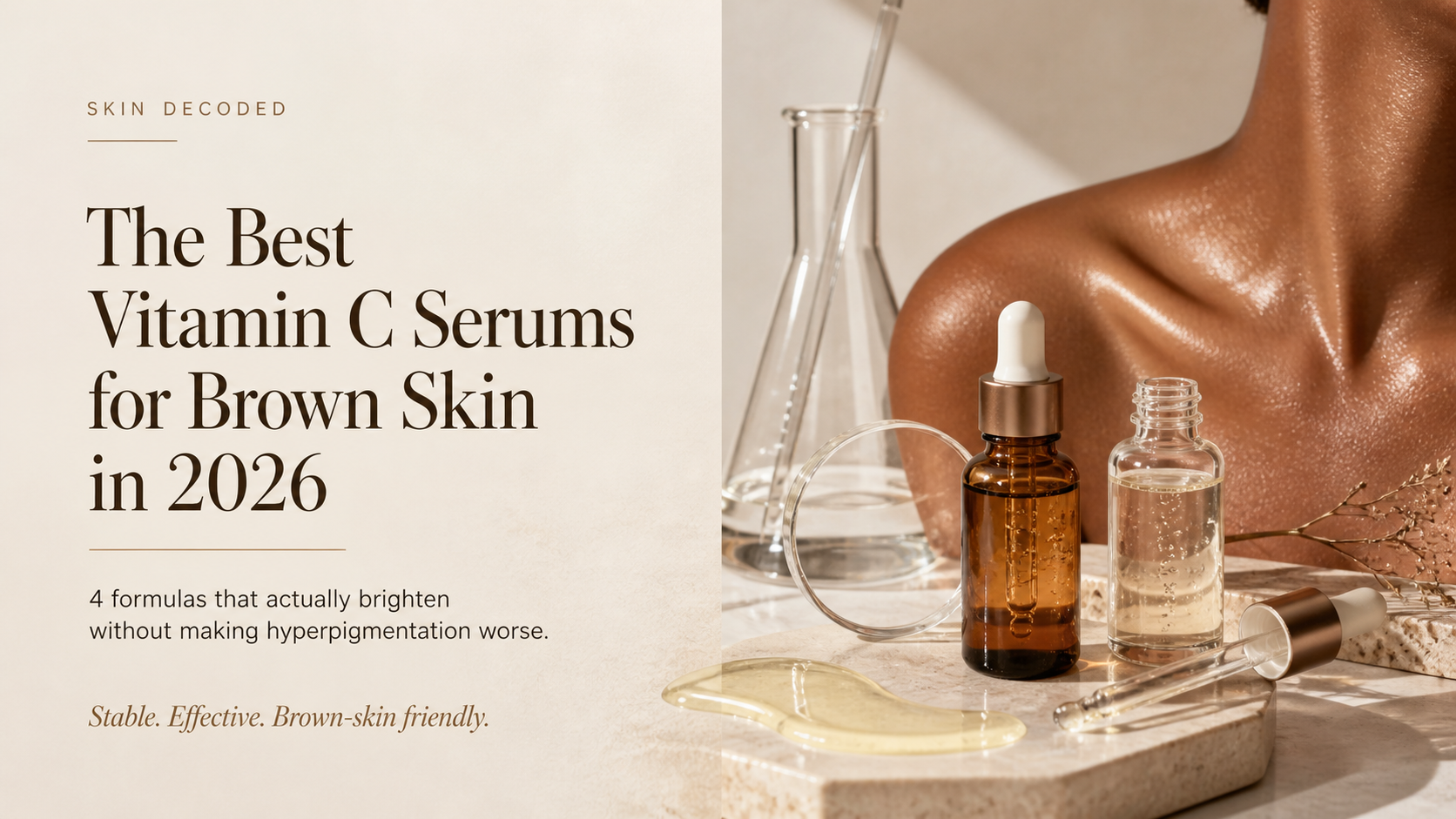
That is the central weirdness of this ingredient. Vitamin C is the most research-backed brightener in skincare, and also the most fragile. Most bottles on Amazon are already oxidized before you open them. On brown skin, an oxidized vitamin C serum can actually deepen pigmentation rather than fade it, which is how a $40 purchase ends up making your hyperpigmentation worse. I pulled the PubMed literature on vitamin C for brown skin so you don't have to. Below is what the evidence actually says, how to spot a dead bottle, and the four serums worth buying in 2026, from $12 drugstore to $185 dermatology-office.
Disclosure: This post contains affiliate links from Amazon and various other affiliates. As an Amazon Associate, I earn from qualifying purchases. If you make a purchase through these links, I may earn a small commission at no extra cost to you.
What Vitamin C Actually Does to Your Skin
Vitamin C is one of the few actives that does more than one useful thing at the same time. It's the reason dermatologists have been quietly recommending it for 30 years, and the reason L'Oreal, Estee Lauder, and every indie brand in between has at least one hero serum built around it.
1. It shuts down the pigment-making enzyme. Vitamin C directly inhibits tyrosinase, the enzyme that triggers melanin production. In plain English: less signal at the start of the pigment production line means less dark spot at the end.
2. It neutralizes the free radicals that drive hyperpigmentation on brown skin. UV, pollution, and blue light trigger oxidative stress in your skin, and that stress is a major driver of pigmentation on melanin-rich complexions. Vitamin C is a potent antioxidant and is especially synergistic with vitamin E and ferulic acid, which is why those three ingredients show up together in the good formulas. In plain English: the serum is not just fading what's there, it's blocking the next round of damage.
3. It stimulates collagen so texture and tone improve together. In the Humbert double-blind 6-month controlled trial, 5 percent vitamin C cream produced significant improvements in skin relief, furrow density, and overall clinical scores versus the excipient. In plain English: on top of fading dark spots, consistent use actually smooths texture and softens fine lines over months.
Why Brown Skin Needs This Ingredient Specifically
On melanin-rich skin, the real game is not just fading what's already there. It's preventing the next round. Our skin responds to any kind of oxidative or inflammatory trigger by pumping out fresh pigment, which is why a sunburn, a breakout, or even a bad day of pollution can leave a new mark weeks later.
A 2021 review in the International Journal of Cosmetic Science ranked vitamin C, ferulic acid, and resveratrol as the three topical antioxidants with the strongest evidence base for oxidative stress-driven hyperpigmentation. In plain English: of all the "antioxidant" serums on the shelf, vitamin C has the receipts, and it's the one you should reach for first.
There is also a cultural reality worth naming. In the US beauty aisle, vitamin C got marketed for 20 years as an "anti-aging" ingredient aimed at a pale, sun-spotted Boomer audience. The brown skin angle (fade post-acne marks, even out tone, block fresh pigment) is newer in the mainstream marketing, but the science was always there. Korean and Japanese dermatology journals have been publishing on vitamin C for pigmentation since the early 2000s. We are finally catching up.
The Honest Caveat
Before you spend money, let me set expectations:
- Think: visibly brighter, more even skin by week 4.
- Think: noticeably faded post-acne marks by week 8 to 12.
- Think: smoother texture and softer fine lines by month 6.
- Not: deep melasma gone in a month.
- Not: a brown-skin bleach. Nothing in a bottle is, and anything that promises that is lying.
- Not: a replacement for sunscreen. Vitamin C actually stops working if you skip SPF, because it's depleted by UV faster than it can rebuild.
Also: if your serum turns orange or amber, it's oxidized. Throw it out. On brown skin, oxidized vitamin C can deepen pigmentation via a byproduct called erythrulose. This is the single most common reason people say "vitamin C doesn't work for me" — they're using a bottle that went bad four weeks ago.
Vitamin C vs Niacinamide on Brown Skin: Which One First?
The most Googled question about brightening on melanin-rich skin in 2026. Honest answer: both, layered, not either/or.
Vitamin C is a morning ingredient. It stops free radicals from UV and pollution before they signal fresh pigment production. It also works faster than niacinamide on existing dark spots.
Niacinamide is a full-day ingredient. It calms the inflammatory response that drives most brown-skin hyperpigmentation, and it's gentle enough to use twice daily without any flare risk.
Optimal 2026 routine for fading dark spots on melanin-rich skin: vitamin C in the morning (before sunscreen), niacinamide morning and night. If you're going to pick one to start, pick vitamin C — you'll see brightness faster. If you want the deep dive on niacinamide specifically, I wrote a separate guide on the four serums worth buying.
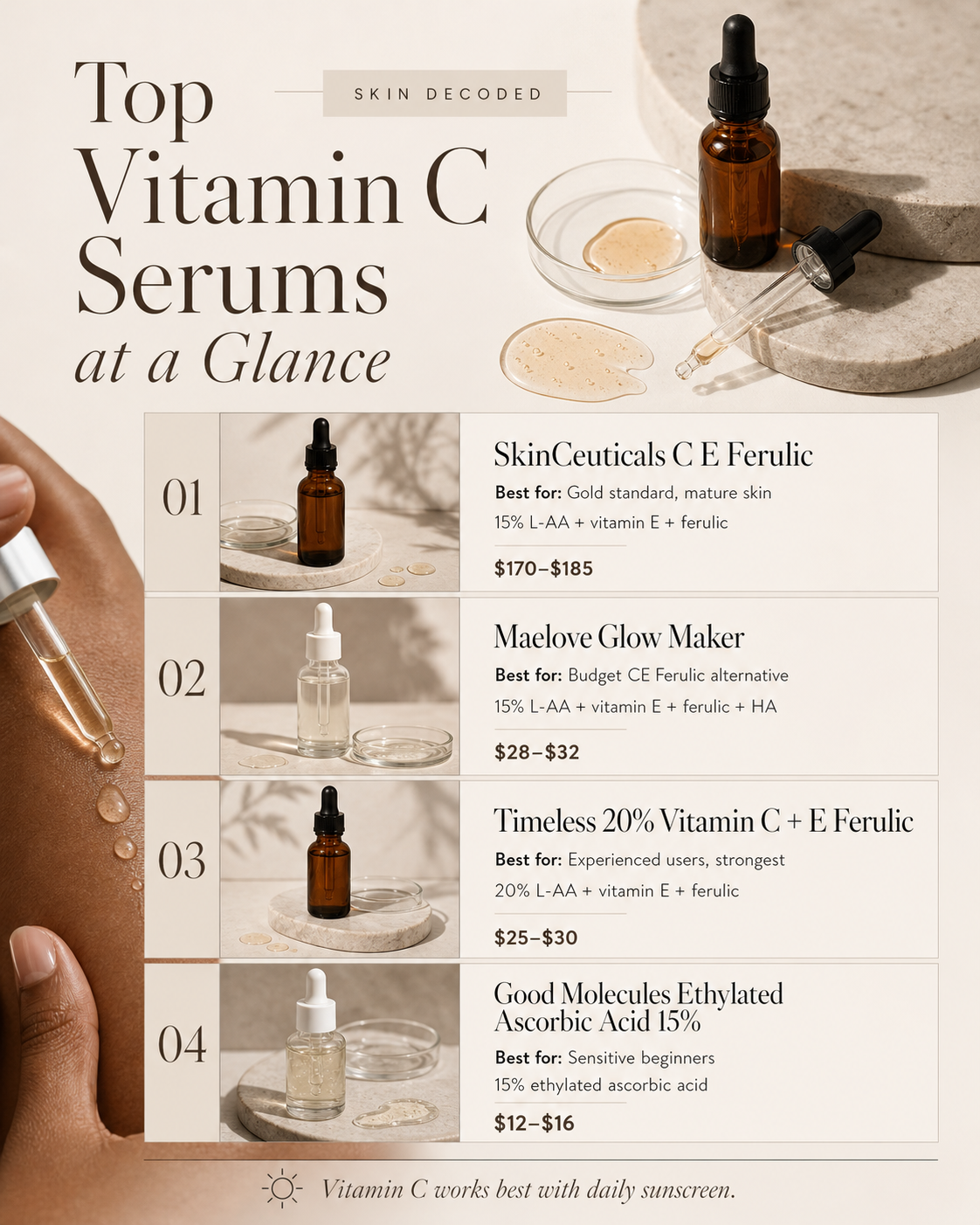
Top Vitamin C Serums at a Glance
| Product | Best for | Key actives | Price |
|---|---|---|---|
| SkinCeuticals C E Ferulic | Gold standard, mature skin | 15% L-AA, vitamin E, ferulic | $170 to $185 |
| Maelove Glow Maker | Budget clone of CE Ferulic | 15% L-AA, vitamin E, ferulic, HA | $28 to $32 |
| Timeless 20% Vitamin C + E Ferulic | Experienced users, strongest | 20% L-AA, vitamin E, ferulic | $25 to $30 |
| Good Molecules Ethylated Ascorbic Acid 15% | Sensitive beginners | 15% ethylated ascorbic acid | $12 to $16 |
SkinCeuticals C E Ferulic (The Original and Still the Benchmark)
This is the formula every other "C + E + Ferulic" serum is trying to copy. 15 percent L-ascorbic acid, 1 percent vitamin E, 0.5 percent ferulic acid, pH below 3.5. It's the serum dermatologists reach for when patients ask "which one, if money were no object," and the formulation is built on the Duke University patent that established the 15 percent threshold as the point at which skin absorption meaningfully kicks in.
The downside is price (roughly $170 to $185) and smell (a faintly hot-dog tang that dissipates in a few minutes). Neither is a dealbreaker if it delivers for your skin. This is the only pick on this list with decades of cumulative clinical use behind it.
Maelove Glow Maker (The $30 CE Ferulic Clone)
If the SkinCeuticals price tag makes you flinch, Maelove Glow Maker is the closest drugstore equivalent on the market. Same 15 percent L-ascorbic acid. Same vitamin E. Same ferulic acid. Same low pH. It layers in hyaluronic acid, which softens the slightly sticky feel of the original.
The brand was founded by a team that included an MIT-trained scientist, and the serum has held a cult following for years. If you want the formulation most closely matched to the published clinical literature without the boutique markup, this is it.
Timeless 20% Vitamin C + E Ferulic (Strongest Concentration)
20 percent L-ascorbic acid is the upper end of what's commonly formulated. In the Humbert 6-month RCT, a lower 5 percent concentration was already strong enough to produce measurable improvements in skin relief and deep furrows, so 20 percent is firmly in "more is not necessarily better" territory. Higher concentrations can mean faster fading on stubborn spots, but also a higher chance of stinging, especially on reactive brown skin.
Timeless is a sensible choice if you've already used 15 percent formulas without issue and want to level up. Not recommended as a first vitamin C.
Good Molecules Vitamin C Serum with Oryzanol (Best for Sensitive Starters)
If pure L-ascorbic acid stings your face, or you've reacted to it in the past, ethylated ascorbic acid is a stabilized derivative that tolerates higher pH formulations without the sting. The clinical evidence base is thinner than L-AA, but ethylated ascorbic acid does convert to active vitamin C in the skin and avoids the irritation that itself can trigger fresh post-inflammatory hyperpigmentation on melanin-rich skin.
Good Molecules' version sits well under $20 and has consistently good reviews from reactive-skin users.
How to Use Vitamin C Without Wasting Your Money
1. Apply to clean, dry skin in the morning. Before moisturizer and sunscreen. Three to four drops is plenty for a whole face.
2. Pair it with SPF every single day, no exceptions. Vitamin C amplifies the effect of sunscreen, and sunscreen protects vitamin C from depletion. They work better together than either does alone.
3. Store it cool and dark. Air and light oxidize L-ascorbic acid fast. If your serum is in a clear bottle sitting on a sunny bathroom counter, it's dying.
4. Trust your eyes more than the label. If it's turned orange, amber, or brown, it's oxidized. Toss it. This is the single most common reason people say vitamin C didn't work for them.
Vitamin C Cost in 2026
The price gap between tiers is the widest of any single ingredient in skincare. Here's the honest map:
- Drugstore tier: $12 to $30 per bottle (Good Molecules, Naturium, The Ordinary's ethylated ascorbic acid).
- Mid tier: $28 to $60 per bottle (Maelove, Drunk Elephant's C-Firma Fresh, La Roche-Posay Pure Vitamin C10).
- Luxury tier: $160 to $200 per bottle (SkinCeuticals, Obagi Pro-C, Revision Vitamin C Lotion 30%).
For a well-formulated 15 percent L-AA + vitamin E + ferulic serum, the clinical evidence does not separate the mid tier from the luxury tier. You are paying for packaging, brand halo, and dermatologist-office distribution, not a more potent active. If you want the evidence-backed formula without the markup, Maelove is where the cost-per-result curve flattens.
Frequently Asked Questions
Is 20% vitamin C too strong for brown skin?
It depends on your starting point. 20 percent L-ascorbic acid is the upper end of what's commonly formulated, and it's where a lot of clinical studies sit. For brown skin prone to irritation-driven pigmentation, starting at 10 to 15 percent is safer. The classic SkinCeuticals formula uses 15, which is arguably the sweet spot.
What's the difference between L-ascorbic acid and its derivatives?
L-ascorbic acid is the pure form. It's the most studied, but it's unstable and needs a low pH to absorb, which can sting sensitive skin. Derivatives like sodium ascorbyl phosphate, magnesium ascorbyl phosphate, and ethylated ascorbic acid are more stable and much gentler, but the clinical evidence base behind them is thinner. For reactive skin, derivatives are the safer entry point.
Can I use vitamin C with niacinamide?
Yes. The old rumor that they cancel each other out came from a 1960s experiment using pure nicotinic acid, not the niacinamide in modern serums. Most dermatologists actively recommend layering them for compounded brightening.
Why does my vitamin C serum turn orange or brown?
That's oxidation. Once vitamin C oxidizes, it stops brightening and can produce a compound called erythrulose that actually causes a faint tan. If your serum has turned orange or amber, replace it. On brown skin, an oxidized serum can subtly deepen pigmentation rather than fade it.
How soon will I see results?
For general brightness and dullness, 2 to 4 weeks. For dark spots, 8 to 12 weeks at minimum. For photoaging improvements like texture and fine lines, the Humbert 6-month trial showed measurable changes at 3 to 6 months.
Should I use vitamin C in the morning or at night?
Morning is where the clinical evidence lives. Vitamin C extends the protective effect of sunscreen against UV and pollution-driven pigmentation, and sunscreen in turn protects the vitamin C from being depleted. Night use isn't wrong, but you miss the synergy with SPF, which is the main reason vitamin C works so well on brown skin in the first place.
What percentage of vitamin C is best for dark skin?
15 percent L-ascorbic acid is the sweet spot backed by the clinical literature. 10 percent works and stings less. 20 percent is faster on stubborn spots but can irritate reactive brown skin, which defeats the purpose. Start at 10 to 15 and only move up if you tolerate it for 4 weeks without any inflammation.
Does vitamin C help with melasma?
It helps, but it's not a frontline melasma treatment. The photoprotective and antioxidant effects slow down new pigment formation, which is useful as a supporting layer. For actually fading melasma, tranexamic acid has the stronger evidence. See my tranexamic acid guide for the full breakdown.
The Science Behind These Picks
The 2017 review in the Journal of Clinical and Aesthetic Dermatology documented four primary mechanisms for topical vitamin C: antioxidant defense against UV-induced free radicals, direct photoprotection, collagen stimulation, and tyrosinase inhibition that reduces melanin formation (Al-Niaimi and Chiang, 2017, PMID: 29104718). The same review emphasized that vitamin C pairs synergistically with vitamin E and ferulic acid, which is why so many good formulas include all three.
A long-term RCT published in Experimental Dermatology tested 5 percent vitamin C cream against its own excipient in a double-blind design over six months. Clinical assessments, self-evaluations, and ultrastructural biopsies all showed significant improvement on the treated side, with measurable increases in skin relief density and reductions in deep furrows (Humbert et al., 2003, PMID: 12823436).
The 2021 review in the International Journal of Cosmetic Science placed vitamin C alongside ferulic acid and resveratrol as the three topical antioxidants with the strongest evidence base for oxidative stress-driven hyperpigmentation (IJCS, 2021, PMID: 34312881). For brown skin, where so much pigmentation is driven by inflammation and environmental stress, that antioxidant coverage is the whole ball game.
Related Reading
- Niacinamide for Dark Spots on Brown Skin — the gentle evening layer that pairs with your morning vitamin C.
- Tranexamic Acid for Melasma — the next step if your pigmentation is hormonal and vitamin C alone isn't moving it.
The Final Take
If you only add one serum to your morning routine this year, make it a well-formulated vitamin C. The evidence is stronger than almost any other active in skincare, the safety profile is excellent, and the benefits compound with consistent use.
My picks: start with Maelove Glow Maker if you want the evidence-backed formula at a reasonable price. Go to SkinCeuticals C E Ferulic if you want the gold standard and can afford it. And if you're reactive, start low with Good Molecules Ethylated Ascorbic Acid 15% and work up from there.