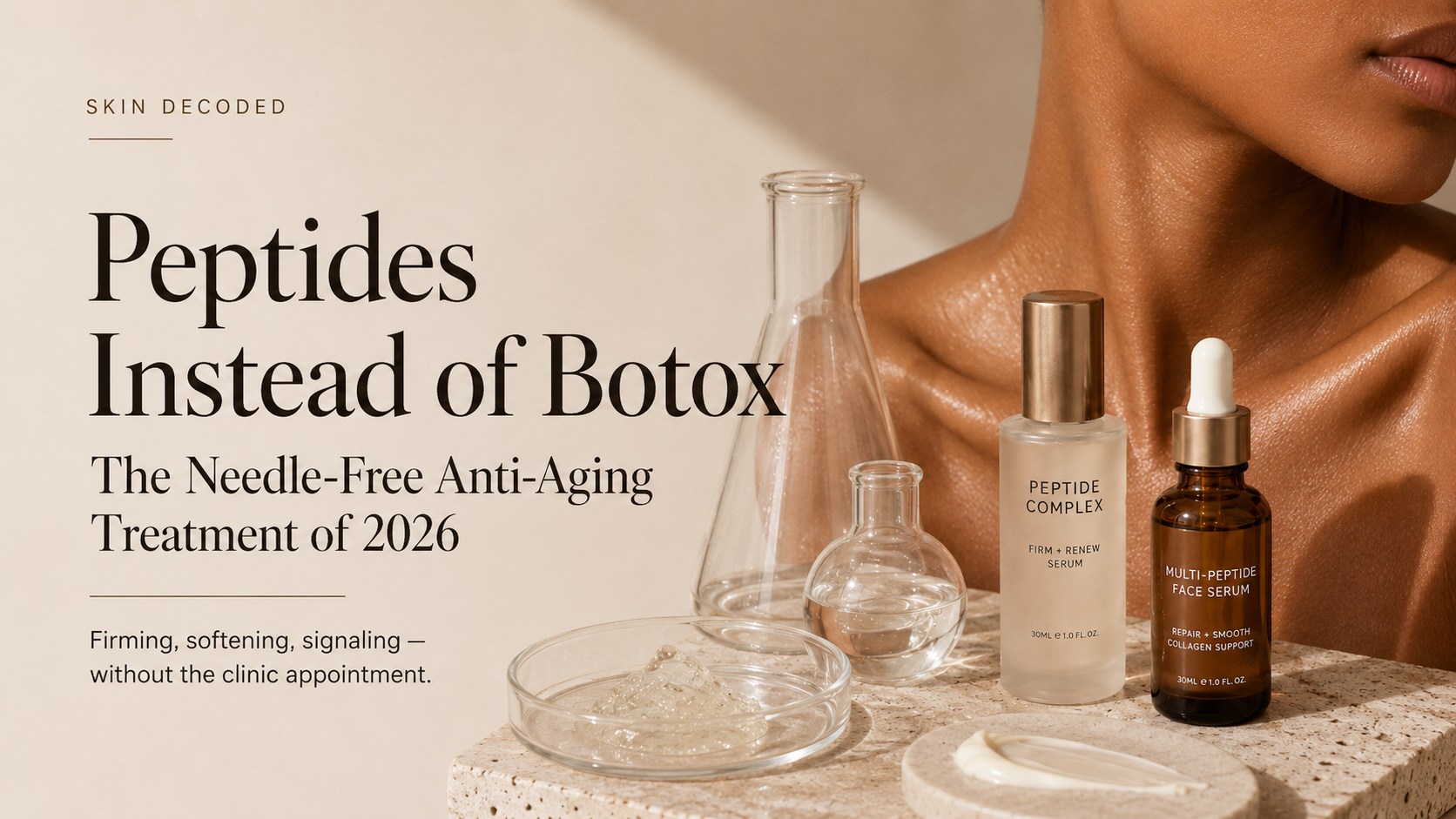
Botox works by paralyzing muscles with a bacterial neurotoxin. In 2001, a Spanish research team in Barcelona wondered whether you could copy a fraction of that effect using a six-amino-acid peptide instead of a needle. They built one — named it acetyl hexapeptide-3, later rebranded as Argireline — and a $400 million cosmetic peptide industry was born from a molecule designed in a biochemistry lab. In 2026, dermatologists in magazines from The New York Times to Allure are calling topical peptides the needle-free anti-aging treatment of the year. That arc, from "lab curiosity" to "the thing your dermatologist mentions before she mentions Botox," is one of the stranger quiet pivots in modern skincare, and it's worth understanding before you buy anything else.
I pulled the PubMed literature on cosmetic peptides so you don't have to. Below is what the research actually says about Argireline, Matrixyl and copper peptides, how much wrinkle reduction to realistically expect, and the four serums worth your money in 2026.
Disclosure: This post contains affiliate links from Amazon and various other affiliates. As an Amazon Associate, I earn from qualifying purchases. If you make a purchase through these links, I may earn a small commission at no extra cost to you.
What Peptides Actually Do to Your Skin
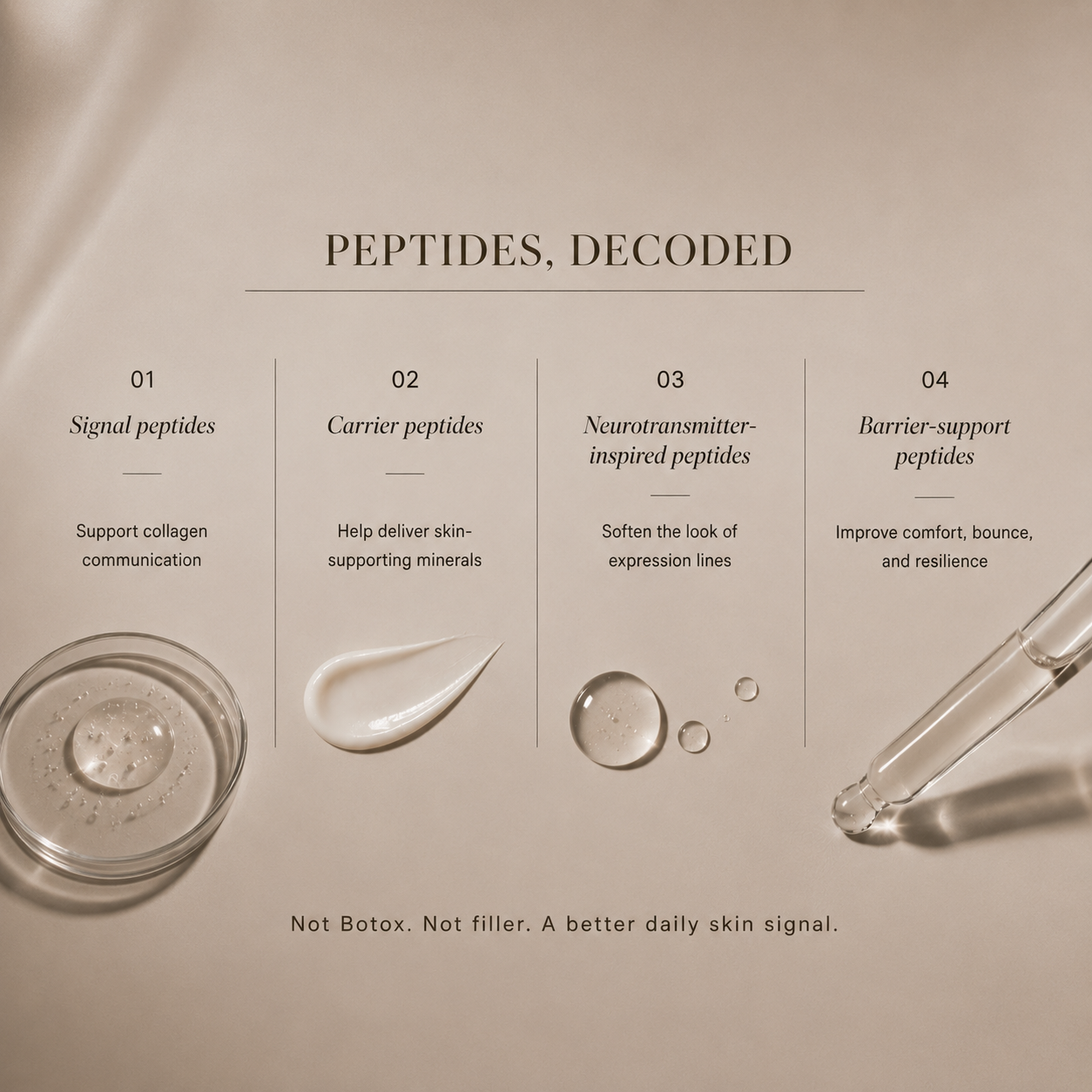
"Peptide" is a catch-all term. It just means a short chain of amino acids, the building blocks of proteins. The cosmetic peptides on the market fall into three functional categories, and they do three different jobs.
1. Signal peptides mimic collagen fragments and trick your skin into building more. Matrixyl (palmitoyl pentapeptide-4, also called pal-KTTKS) is the best-studied signal peptide. When your skin senses these fragments, it interprets them as evidence that collagen has been damaged and responds by pumping out fresh collagen and fibronectin. In plain English: you put a tiny piece of a protein on your face, and your skin responds by building more of the real thing.
2. Neurotransmitter-inhibiting peptides soften expression lines. Argireline is derived from the N-terminus of SNAP-25, the exact protein Botox targets. It gets in the way of the muscle-signal cascade that causes your forehead to crease when you raise your eyebrows. The Wang et al. 2013 trial, the only large controlled study on topical Argireline, showed a 48.9 percent reduction in peri-orbital wrinkle depth after 4 weeks of twice-daily use on 60 Chinese subjects. In plain English: your forehead still moves, but it creases a little less aggressively when it does.
3. Carrier peptides deliver trace minerals to your fibroblasts. Copper tripeptide-1 (GHK-Cu) binds to a copper ion and escorts it into your skin cells, where it activates the fibroblasts responsible for building collagen, elastin and glycosaminoglycans. In plain English: it's a mineral delivery system for the cells that decide how firm your skin will be in five years.
Why Dermatologists Are Recommending Peptides in 2026
The shift isn't about peptides suddenly becoming better. It's about the cost of Botox, the rise of "Botox face," and a generation of patients asking for softer, more cumulative treatments before they commit to quarterly needles.
Three things line up in favor of peptides right now.
They have a real clinical record. The Robinson et al. 2005 split-face trial on Matrixyl — 93 women, 12 weeks, double-blinded — showed measurable reductions in wrinkle length, wrinkle depth and overall skin roughness. In plain English: this isn't just marketing. Peer-reviewed evidence exists for at least two of the three peptide categories.
They are non-irritating for brown skin. Retinol and acids, the other two anti-aging pillars, can trigger post-inflammatory hyperpigmentation on melanin-rich skin. Peptides don't exfoliate, don't photosensitize, and don't typically provoke the inflammatory cascade that leaves dark marks on brown complexions. For Fitzpatrick IV to VI skin, they're often the lowest-risk starting point in anti-aging.
They cost $10 to $90 per bottle, not $800 per session. A year of quarterly Botox runs $1,800 to $3,200. A year of peptide serum runs $60 to $300. For early prevention and maintenance, the economics have flipped.
The Honest Caveat
Peptides are real, but the "Botox in a bottle" framing is marketing. Let me set expectations before you spend any money.
- Think: subtle softening of fine expression lines over 8 to 12 weeks.
- Think: a gradual firming of the skin surface, visible in photos side-by-side but not dramatic in the mirror.
- Think: a barrier-friendly anti-aging option if retinol irritates you or you're in your 20s or early 30s doing prevention.
- Not: frozen forehead or a Botox-style erase of the 11s between your brows.
- Not: results visible in two weeks. The shortest trial showing significant change was 4 weeks, and that was the best-case scenario.
- Not: a replacement for sunscreen. UV damage undoes peptide work faster than peptides can build new collagen.
If your primary concern is deep, dynamic wrinkles that stay after you stop making the expression, peptides alone won't get you there. For that tier of concern, Botox or a prescription retinoid plus peptides is the real-world combo.
Peptides vs Retinol: Do You Need Both?
They target different steps, which is why dermatologists increasingly recommend layering them instead of picking.
Retinol speeds up cell turnover, thickens the deeper layers of skin, and increases collagen synthesis through the retinoic acid receptor pathway. It is the most clinically validated anti-aging molecule in existence. It is also irritating, photosensitizing and slow to tolerate, especially on brown skin.
Peptides work on the signaling side — they tell fibroblasts to build more collagen and they dampen expression-line muscle activity. They don't exfoliate, so they don't increase irritation or pigment risk.
The optimal routine for most melanin-rich skin in 2026: peptides in the morning (layered under sunscreen, no photosensitivity risk), retinol at night (after you've built tolerance), niacinamide or vitamin C to stabilize the barrier. If you're a retinol beginner or reactive, start with peptides alone for 8 weeks before introducing retinol.
Top Peptide Serums at a Glance
| Product | Best for | Key actives | Price |
|---|---|---|---|
| The Ordinary Argireline Solution 10% | Expression lines, budget pick | Acetyl hexapeptide-8 10% | $8 to $12 |
| The Ordinary Buffet + Copper Peptides 1% | Full-spectrum peptide stack | Matrixyl, Argireline, Copper peptides | $28 to $32 |
| Medik8 Liquid Peptides Advanced MP | Serious anti-aging, mid-range | 8 peptides, including pal-KTTKS | $72 to $85 |
| Peter Thomas Roth Peptide 21 Serum | Mature skin, splurge | 21 peptide complex, probiotics | $98 to $110 |
The Ordinary Argireline Solution 10% (Best Budget Expression-Line Pick)
At this price you cannot beat it. Ten percent is the concentration used in the Wang et al. 2013 peri-orbital trial — the one that showed 48.9 percent wrinkle depth reduction after 4 weeks of twice-daily use. The formula is water-light, fragrance-free, and designed to slip under anything heavier you apply on top.
Apply to clean skin morning and night before moisturizer. Focus on crow's feet, forehead lines and between the brows — anywhere your face creases when you make an expression. Skip the lower face; Argireline does nothing for structural collagen loss, which is where the lower face gets its aging signals.
The Ordinary Buffet + Copper Peptides 1% (Best Full-Spectrum Pick)
This is the peptide serum I recommend if you only want to buy one bottle. The Buffet base contains Matrixyl 3000, Argireline, SYN-AKE, and three other peptide complexes. The 1% copper peptide add-on layers GHK-Cu on top. You are effectively getting three peptide categories in one formula: signal peptides (Matrixyl), neurotransmitter-inhibitors (Argireline), and carrier peptides (copper).
Downside: the copper gives it a visible blue tint. Apply at night after cleansing, before moisturizer. Do not layer directly on top of vitamin C — the two actives destabilize each other.
Medik8 Liquid Peptides Advanced MP (Best Mid-Range)
The step up from The Ordinary. Medik8 packs eight different peptides including a clinical-grade dose of pal-KTTKS (Matrixyl) alongside a soothing blend of amino acids and glycerin. The formula is noticeably more elegant — a tacky gel-serum that layers well under makeup — and the packaging is airless, which protects the peptides from oxidation.
This is the serum to graduate to once you know peptides work for you and you're ready to invest in a more stable, more bioavailable delivery system. Twice daily application over 8 to 12 weeks is where the Medik8 clinical data shows its best results.
Peter Thomas Roth Peptide 21 Serum (Best Splurge for Mature Skin)
If you are in your 40s or beyond and your concern is structural: loss of firmness around the jawline, deepening nasolabial folds, and fine lines that stay visible at rest, Peter Thomas Roth's 21-peptide complex is the most complete formula in the splurge tier. It stacks signal peptides, neuropeptides and carrier peptides together with probiotic lysates that support the skin microbiome.
Pair it with a prescription-strength retinoid (tretinoin or adapalene) at night for the strongest possible anti-aging outcome without committing to Botox. The combination of retinoid-driven cell turnover plus peptide-driven collagen synthesis is the most evidence-based non-injectable stack in dermatology in 2026.
How to Use Peptides for Best Results
1. Apply to clean, slightly damp skin twice a day. Morning for Argireline, night for Matrixyl or copper peptides. Many all-in-one peptide serums are safe both morning and night.
2. Layer early in the routine. Peptides are water-based, so they go on after toner and before heavier creams, oils or sunscreens.
3. Do not layer peptides with strong acids in the same step. Low pH environments (glycolic, salicylic, L-ascorbic acid at 15 to 20 percent) can denature peptides. Use acids at night and peptides in the morning, or alternate nights, or wait 20 minutes between them.
4. Give it real time. Expect at least 8 weeks to see any visible softening, and 12 weeks for structural changes. Peptides are a slow-burn active — they work best as a daily habit for 6 months or more, not as a 4-week experiment.
Peptide Cost in 2026
This is one of the anti-aging categories where drugstore formulas hold up remarkably well against luxury ones.
- Drugstore tier: $8 to $30 per bottle (The Ordinary, Inkey List, Naturium).
- Mid tier: $45 to $90 per bottle (Medik8, Paula's Choice, Drunk Elephant).
- Luxury tier: $98 to $280 per bottle (Peter Thomas Roth, Olay Regenerist Max, SkinMedica).
For a single-peptide serum like Argireline or Matrixyl, the clinical evidence does not separate the drugstore tier from the luxury tier. You are paying for formulation elegance, packaging stability, and bundled supporting actives. For multi-peptide stacks, the mid-range and luxury tiers do offer a meaningful advantage in peptide variety and stability, but only if you're willing to commit to daily use.
Frequently Asked Questions
Do topical peptides actually work like Botox?
Not exactly. Botox paralyzes the muscle that creates the wrinkle. Argireline mimics a tiny fragment of the protein Botox targets and can partially dampen muscle contraction at the surface. The published trials show roughly 10 to 48 percent wrinkle reduction over 4 to 8 weeks, which is real but meaningfully less than in-office Botox. Think subtle softening, not frozen.
Are peptides safe for brown skin?
Yes, and in many ways they are the lowest-risk active in the anti-aging aisle for melanin-rich skin. Peptides are non-exfoliating and non-photosensitizing, so they won't trigger the post-inflammatory hyperpigmentation that retinol and acids sometimes do on brown complexions. They're a great bridge if retinol irritates you.
Argireline vs Matrixyl — which is better?
They target different wrinkles. Argireline targets expression lines caused by repetitive muscle motion, like crow's feet and forehead lines. Matrixyl targets structural collagen loss, like the creases around your nasolabial fold and perioral area. For a complete routine, layer both: Argireline in the morning, Matrixyl at night.
How long before peptides show results?
The original argireline trial measured effects at 4 weeks; the Matrixyl 12-week trial is the most-cited data. Realistically, expect 8 to 12 weeks of consistent twice-daily use before you see a measurable softening of fine lines. Consistency matters more than concentration.
Do copper peptides really grow collagen?
Copper tripeptide-1 (GHK-Cu) has stronger in-vitro data than clinical data. The petri-dish studies are striking, with dramatic fibroblast activation and collagen synthesis. The human-skin studies are smaller and less conclusive. Most dermatologists categorize GHK-Cu as a supportive active, not a headliner.
Can I use peptides with retinol?
Yes, and most anti-aging routines benefit from the combo. Peptides work on the structural protein layer; retinol works on cell turnover. They target different steps, so they stack well. If you're new to retinol, start peptides first — they're a gentler entry point and will strengthen your barrier before you introduce the more irritating active.
Peptides vs Botox — is it actually cheaper?
Annually, yes. A year of quarterly Botox runs $1,800 to $3,200 depending on units and location. A year of The Ordinary Argireline Solution 10% at $9 a bottle, used twice daily, runs about $60. The trade-off: Botox produces a dramatic, visible smoothing effect; peptides produce a subtle, cumulative one.
Can peptides replace Botox completely?
For most people, no. If your primary concern is deep dynamic wrinkles, the 11s between your brows, forehead lines that stay after you stop frowning, peptides won't replicate Botox. But for early prevention, maintenance between Botox appointments, or a needle-free starting point in your 20s and 30s, peptides are the most legitimate at-home option on the market.
The Science Behind These Picks
The clinical evidence for Argireline rests primarily on the Wang et al. 2013 controlled trial of 60 Chinese subjects treated twice-daily with 10 percent acetyl hexapeptide-8 liposomal cream for 4 weeks, which measured a 48.9 percent reduction in peri-orbital wrinkle depth compared with 0 percent in the placebo group (Wang et al., 2013, Am J Clin Dermatol, PMID: 23417317).
The case for Matrixyl (palmitoyl pentapeptide-4) comes from the Robinson et al. 2005 split-face randomized controlled trial of 93 women using 3 parts per million pal-KTTKS twice daily for 12 weeks, which demonstrated significant reductions in wrinkle length, wrinkle depth and skin roughness versus vehicle control (Robinson et al., 2005, Int J Cosmet Sci, PMID: 18492182).
Related Reading
- Niacinamide for Dark Spots on Brown Skin — the barrier-building companion to any peptide routine.
- Best Vitamin C Serums for Brown Skin — the morning antioxidant that protects the collagen peptides help you build.
- Caffeine vs Peptides vs Retinol for Under-Eye Care — how peptides perform specifically on the periorbital skin.
The Final Take
If you are considering Botox and not sure you're ready for it, or you've already committed and want something to do in the months between appointments, topical peptides are the most evidence-backed needle-free option on the market in 2026. Start with Argireline if expression lines are your concern, Matrixyl if you're worried about structural collagen, or a multi-peptide serum like The Ordinary Buffet if you want to cover both at once. Give it 12 weeks, take a selfie in the same light every two weeks, and let the photo roll tell you whether it's working.
My pick to start: The Ordinary Argireline Solution 10% if you're 25 to 35 and doing prevention, or The Ordinary Buffet + Copper Peptides 1% if you want full-spectrum peptide coverage in one bottle.