At-home LED masks have become the one of the biggest trends in beauty right now. Some people swear they changed their skin. Others use them for a week, forget about them, and never touch them again. And for anyone considering spending hundreds of dollars on one, that leaves a pretty obvious question: are they actually worth it?
The answer is not a simple yes or no.
There is legitimate science behind red light therapy, especially in certain areas of dermatology, but the consumer version is often marketed with more confidence than the evidence can support. Here is the honest, science-backed truth about what at-home LED masks can do, what they probably cannot, and whether they deserve a place in your routine.
What Is Red Light Therapy and How Does It Work?
Red light therapy is a noninvasive treatment that uses specific wavelengths of red and near-infrared light to affect how skin cells function. In dermatology, this is called photobiomodulation, which refers to using light to support cellular signaling and repair rather than damaging the skin.
In simpler terms, red light therapy is meant to encourage skin to function a little more efficiently. It is often used in conversations around inflammation, healing, acne, and skin rejuvenation because these wavelengths appear to influence cellular energy production and other biologic pathways involved in repair.
Do At-Home LED Masks Actually Work?
The short answer is yes, but only within a narrower window than beauty marketing usually suggests.
At-home LED masks are not fake. Light-based therapy has real dermatologic uses, and there is legitimate research behind both red and blue light in skin care. But that does not mean every mask on the market is equally effective, or that every claim attached to one is well supported.
The most honest way to think about these devices is as a supportive treatment. They may help with certain skin concerns over time, especially when used consistently, but they are not the kind of product that typically creates dramatic overnight change. If you are expecting a red light therapy mask to work like a professional laser, a prescription retinoid, or a major in-office procedure, you will probably be disappointed.
If you are open to gradual improvement, though, the category becomes much more reasonable.
What At-Home LED Masks Are Best For
The strongest case for at-home LED masks is not “anti-aging” in the broadest possible sense. It is more specific than that.
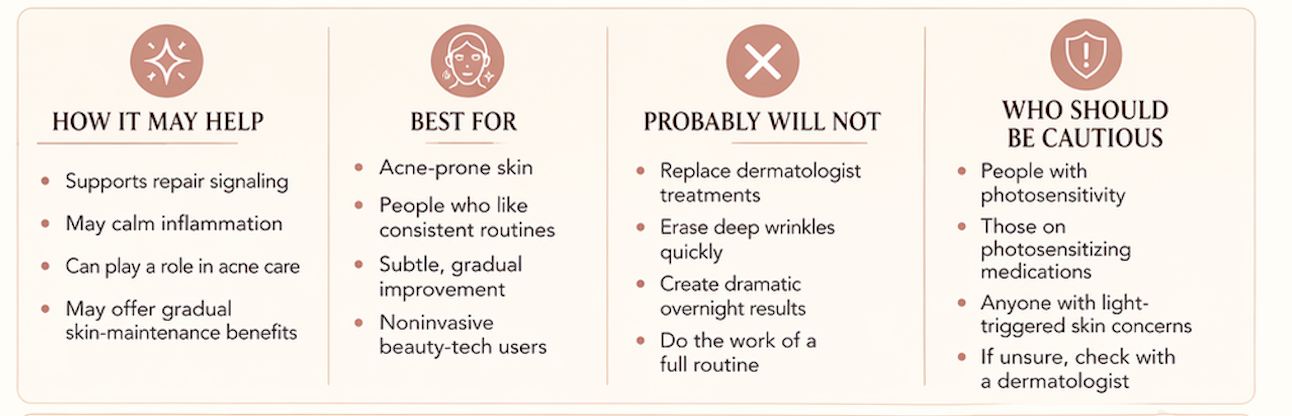
These devices make the most sense for people who want a noninvasive, routine-based treatment that may help with acne, inflammation, and subtle skin-quality concerns over time. That is a much less glamorous promise than the marketing language most brands use, but it is also much closer to what the evidence actually supports.
For acne, light-based treatment has one of the clearer evidence lanes in dermatology. Blue light is commonly discussed for acne because it targets acne-related pathways, while red light is more often positioned as a supportive option for inflammation and healing. This does not mean every at-home LED face mask will outperform a standard acne routine, but it does mean the category has a more believable role here than in some of its more exaggerated wrinkle-reversal claims.
For skin rejuvenation, the picture is more mixed. There is promising research suggesting red and near-infrared light may support skin repair, texture, and fine lines over time, but the results are not as uniform or as dramatic as marketing often implies. If you are buying a red light therapy mask for mild skin dullness or gradual texture support, that is a more realistic goal than expecting it to erase deeper wrinkles.
Do LED Masks Help Acne?
This is probably the most evidence-backed question in the whole category.
If your main goal is acne, especially mild to moderate inflammatory acne, an LED mask makes more sense than if your goal is total facial rejuvenation. That does not mean light therapy is automatically the best acne treatment, but it does mean it has a clearer scientific rationale.
This is also where expectation-setting matters. An at-home LED mask may help support acne treatment, but it should not automatically replace proven basics if those are already working for you. It makes more sense as an adjunct than as a miracle cure.
If you are acne-prone and like consistency, gadgets, and low-effort routines, this is one of the stronger reasons to buy into the category.
Can Red Light Therapy Help Wrinkles and Skin Texture?
Possibly, but this is where beauty marketing usually gets ahead of the science.
Red light therapy is often sold as a collagen-supporting, wrinkle-softening treatment, and there is some research pointing in that direction. But the evidence is still much more mixed than the messaging you see online. The better way to frame red light therapy for wrinkles is as a gradual, supportive option for mild signs of aging, not a dramatic correction tool.
That distinction matters because it changes who will actually be happy with a device.
If you want something that may help your skin look a little smoother, a little calmer, or a little more even over time, an at-home LED mask may be worth trying. If you want sharper lifting, resurfacing, or major wrinkle reduction, you are asking the category to do more than it reliably does.
Why Results Can Be So Inconsistent
One reason at-home LED masks are so polarizing is that the experience is extremely dependent on the device and the person using it.
The science on light therapy is about wavelengths, dose, consistency, and treatment parameters, not just the fact that a mask lights up. Two devices can both be called “red light therapy masks” and still differ in ways that matter. On top of that, home-use devices generally operate with lower energy output than medical devices, which is one reason they are more convenient and accessible but also less dramatic.
Then there is the human factor. These devices usually work on a cumulative timeline. Someone who uses a mask regularly for months is having a very different experience from someone who tries it four times and gives up. That does not mean every consistent user will see major results. It just means this category tends to reward patience more than impulse.
What At-Home LED Masks Probably Cannot Do
This is the part of the conversation that beauty brands are usually less excited to emphasize.
At-home LED masks probably cannot replace in-office procedures. They probably cannot produce dramatic lifting. They probably cannot erase deep wrinkles quickly. And they definitely should not be treated like a guaranteed shortcut to professionally treated skin.
That does not make them useless. It just places them in the right category.
The best-case use of an at-home LED mask is as part of a broader skin-care routine for someone who enjoys the ritual, likes device-based beauty, and is comfortable with slower payoff. The worst-case use is expecting a few minutes of red light at home to do the work of a much stronger clinical treatment.
How to Use an At-Home LED Mask for Best Results
If you do decide to buy one, the smartest approach is usually the least complicated one.
Use it on clean, dry skin. Follow the schedule the device gives you rather than trying to overdo it. Stay consistent long enough to judge it fairly. And do not build an unrealistic routine around it.
A lot of people make the mistake of buying a device and then expecting the device itself to carry their entire skin routine. In reality, an LED face mask works best when the rest of your routine is already solid. That means barrier support, daily sunscreen, and realistic expectations.
The device should be an add-on, not the entire strategy.
Who Should Be Careful With LED Face Masks?
Although LED therapy is generally described as safe and well tolerated, that does not mean every person should use every device without thinking about it.
If you have a condition associated with light sensitivity, a history of pigment issues that worsen with visible light, or you take medications that increase photosensitivity, it is worth being more cautious. Eye safety also matters, especially for people with underlying ocular conditions or unusual sensitivity. A consumer device may still be fine, but this is the kind of category where “generally safe” is not the same thing as “universally appropriate.”
If your skin is reactive, your pigmentation is easily triggered, or your medical history is more complicated than average, this is one of those times when checking with a dermatologist is actually reasonable.
Are At-Home LED Masks Worth It?
For the right person, yes.
At-home LED masks are worth considering if you like routine, can be consistent, and want a device that may offer gradual support for acne or mild skin-quality concerns. They make less sense if you want immediate change, hate maintenance, or are buying with the expectation that a mask will replace stronger treatments.
That is really the whole story.
At-home LED masks sit in the middle ground between real dermatologic science and very polished beauty theater. The science underneath the category is real. The marketing layered on top of it is often much more ambitious than the evidence. If you can hold both of those truths at the same time, it becomes much easier to decide whether one belongs in your routine.
Which LED Masks Should I Buy?
Not every LED mask is made equally. Make sure you are getting a device that is from a reputable company that clearly states wavelength logic, treatment guidance, and consistent usage instructions.
Some of my personal recommendations are:
And because people rarely buy devices in isolation, the support products that fit naturally around them are:
The bottom line
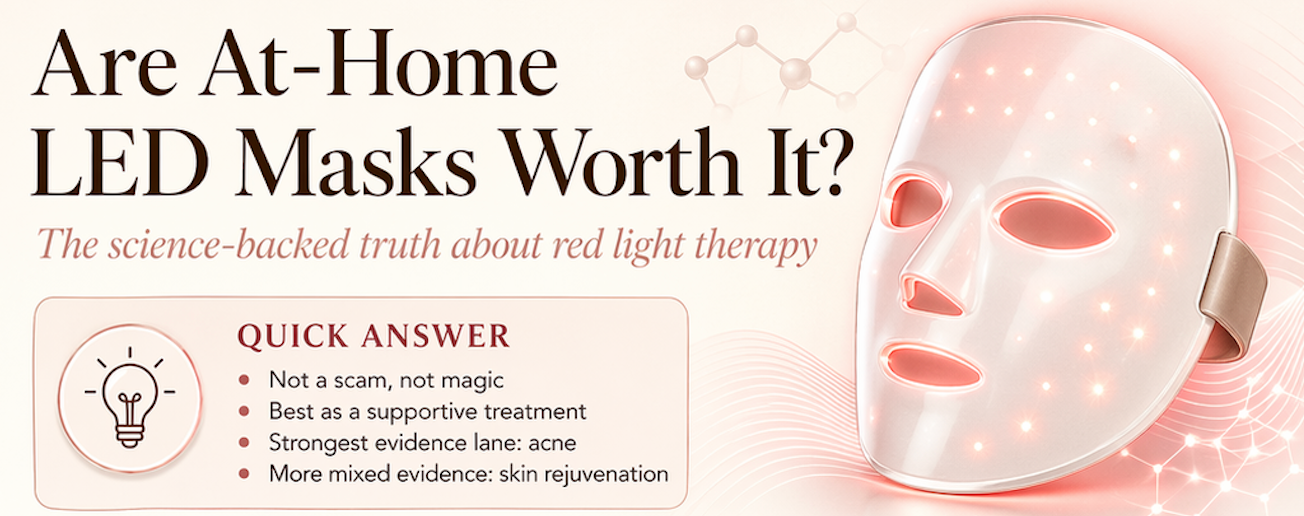
If you want the most balanced answer, here it is: at-home red light therapy masks are not a scam, but they are also not magic.
They are most believable as a supportive skin-care tool, especially for acne and gradual skin-maintenance goals. They are much less convincing when they are sold as a shortcut to dramatic anti-aging results.
So if you are deciding whether to spend the money, the better question is not just “Do LED masks work?” It is “Do they work well enough for my goals, my patience level, and the kind of routine I will actually stick to?”
For some people, the answer is yes. For others, the money is probably better spent elsewhere.
FAQ: At-Home LED Masks
Do at-home LED masks really work?
They can, but mostly as supportive treatments. The evidence is more convincing for some uses, especially acne, than for dramatic anti-aging claims.
How long does it take to see results from an LED mask?
Usually not quickly. This is a category where consistency matters more than one impressive session. Think in terms of weeks to months, not days.
Are LED masks good for acne?
They can be a reasonable option for acne-prone skin, especially when blue light is part of the device design. Acne is one of the stronger evidence lanes in the LED category.
Can red light therapy help wrinkles?
Possibly, but it is better framed as gradual support for mild texture and aging concerns than as dramatic wrinkle correction.
Are at-home LED masks safe?
Generally, LED therapy is considered well tolerated for many users, but “safe” does not mean “for everyone without exception.” If you are unusually light-sensitive, have a skin condition that flares with light, or take medications that increase photosensitivity, it is worth being more careful.
Can LED masks replace dermatologist treatments?
No. They make more sense as an adjunct than as a substitute for in-office procedures, prescription treatments, or basic skin-care habits.
Sources
- Moon JY, et al. "Utilization of light-emitting diodes for skin therapy: Systematic review and meta-analysis." 2023. PubMed: https://pubmed.ncbi.nlm.nih.gov/36310510/
- Bragato EF, et al. "Role of photobiomodulation application frequency in facial rejuvenation: randomized, sham-controlled, double-blind, clinical trial." 2025. PubMed: https://pubmed.ncbi.nlm.nih.gov/40167796/
- Ershadi S, et al. "At-Home LED Devices for the Treatment of Acne Vulgaris: A Systematic Review and Meta-Analysis." 2025. PubMed: https://pubmed.ncbi.nlm.nih.gov/40042878/
- Park SH, et al. "Clinical study to evaluate the efficacy and safety of home-use LED and IRED mask for skin rejuvenation." 2025. PubMed: https://pubmed.ncbi.nlm.nih.gov/39960921/