Niacinamide is, technically, a vitamin.
The same vitamin B3 that's powdered into your multivitamin, dusted onto breakfast cereal, and in the can of tuna currently sitting in your pantry. In the 1930s it was the treatment for a deficiency disease called pellagra. In 2026, smeared on your face at 5 percent, it happens to be the single most peer-reviewed ingredient for fading dark spots on brown skin. That progression from "pellagra medicine" to "viral skincare" is one of the weirder arcs in modern dermatology, and it is the reason this one bottle is worth understanding before you buy anything else.
I went through the PubMed literature on niacinamide and hyperpigmentation so you don't have to. Below is what the research actually says, what it doesn't, and the four serums I'd recommend anyone to buy.
Disclosure: This post contains affiliate links from Amazon and various other affiliates. As an Amazon Associate, I earn from qualifying purchases. If you make a purchase through these links, I may earn a small commission at no extra cost to you.
What Niacinamide Actually Does to Your Skin
Most brighteners go after one specific step in how your skin makes dark spots. Hydroquinone shuts down the enzyme that builds pigment. Vitamin C quenches the free radicals that tell your skin to build it in the first place. Niacinamide takes a third route, and it's the route that matters most if you have brown skin.
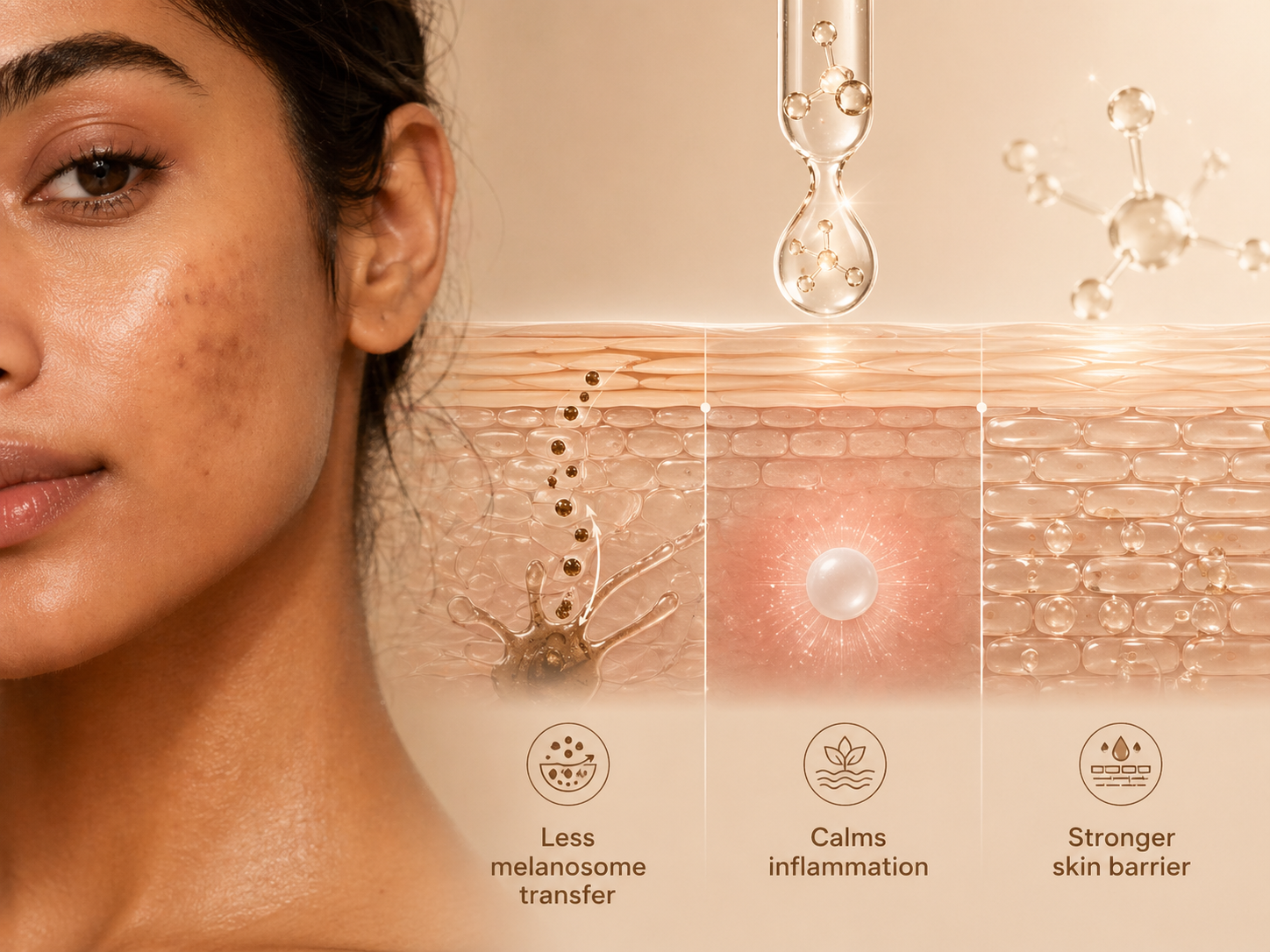
1. It blocks melanin from reaching the surface of your skin. The foundational Procter and Gamble study showed 35 to 68 percent inhibition of melanosome transfer in a coculture of pigment-producing cells and the keratinocytes they normally dump pigment into (Hakozaki et al., 2002). In plain English: your skin can keep making pigment, but far less of it actually lands where you'd see it as a dark spot.
2. It calms the inflammation that causes post-inflammatory hyperpigmentation. Brown skin has a specific problem: any time we get a breakout, a scratch, a waxing irritation, or even a mosquito bite, our cells respond by pumping out extra pigment as a defense move. Niacinamide dials down that inflammatory response at the cellular level (Boo, 2021). In plain English: less inflammation triggered by life means fewer new dark marks forming in the first place.
3. It strengthens your skin barrier so other actives work better. The same mechanistic review showed niacinamide replenishes the NAD coenzyme pool that powers your cells, increases ceramide production, and reduces transepidermal water loss (Boo, 2021). In plain English: a stronger barrier means you can tolerate retinol, exfoliants, and vitamin C without them triggering fresh hyperpigmentation as a reaction.
Why Brown Skin Benefits Most From This Ingredient
Melanin-rich skin is biologically more reactive. Our melanocytes are larger, more active, and more easily provoked, which is why a single pimple can leave a mark that outlasts the breakout by six months. The Fitzpatrick IV to VI literature is full of this story: the ingredient that works best isn't the strongest one, it's the one that doesn't trigger inflammation on the way to the target.
That's the niacinamide edge. In the 12-week controlled trial that followed the original Hakozaki paper, 5 percent niacinamide produced significant reductions in hyperpigmentation without a single reactive side effect in the study population (Bissett et al., 2005). In plain English: it worked, and it didn't leave anyone worse than it found them. For brown skin, that second part is the entire game.
The 2022 systematic review of melasma treatments formally added niacinamide to the list of recommended adjuvants for skin of color, specifically because of its tolerability profile (Gonzalez-Molina et al., 2022). In plain English: dermatologists treating brown skin now reach for it as a first layer before stacking anything stronger.
The Honest Caveat
Niacinamide is real, but TikTok is not. Let me set expectations before you spend any money.
- Think: slow, gradual lightening of existing post-inflammatory marks over 8 to 12 weeks.
- Think: fewer new dark spots forming when you pick at something or get a breakout.
- Think: a smoother, more even surface tone by month three.
- Not: melasma erased in two weeks.
- Not: deep, old pigment (hormonal, sun-stacked, or scar-linked) completely gone with niacinamide alone.
- Not: a replacement for sunscreen. If you skip SPF, niacinamide cannot outrun fresh UV damage.
For anything hormonal or stubborn, niacinamide is the base layer, not the headliner. You'll want to pair it with tranexamic acid, azelaic acid, or a prescription cream from a dermatologist.
Top Niacinamide Serums at a Glance
| Product | Best for | Key actives | Price |
|---|---|---|---|
| The Ordinary Niacinamide 10% + Zinc 1% | Oily, acne-prone, PIH | Niacinamide 10%, Zinc PCA | $7 to $11 |
| Good Molecules Niacinamide Serum | Sensitive beginners | Niacinamide 10% | $8 to $10 |
| Glow Recipe Niacinamide Dew Drops | Dry, dull skin wanting glow | Niacinamide 5%, watermelon | $32 to $36 |
| Paula's Choice 10% Niacinamide Booster | Mature skin, pores plus spots | Niacinamide 10%, vitamin C, licorice | $42 to $48 |
The Ordinary Niacinamide 10% + Zinc 1% (Best Overall Value)
This is the serum that put niacinamide on the map for a whole generation of skincare shoppers. At the price of a Starbucks latte, you get 10 percent niacinamide buffered with zinc PCA, which also helps regulate oil. It's the most tested, most reviewed, and most duplicated formula in the category.
The catch: 10 percent is at the upper end of tolerated concentrations for some brown complexions. If you tingle, flush, or break out on first use, drop to a 5 percent formula. The brightening data lives at 5 percent, not 10 — the 10 percent number is a marketing figure, not the clinical one.
Good Molecules Niacinamide Serum (Best for Sensitive Beginners)
If you've never used niacinamide before, or if The Ordinary's version gave you a reaction, Good Molecules offers a near-identical formula at a similarly friendly price. The texture is lighter, the finish less tacky, and reviews from deeper-skinned users consistently flag it as non-reactive.
Pair it with a ceramide moisturizer at night and a broad-spectrum sunscreen by day. Skipping SPF with an active in your routine is like running a bath with the drain open.
Glow Recipe Niacinamide Dew Drops (Best for Dry, Dull Skin)
At 5 percent niacinamide, this sits exactly at the concentration used in the original clinical studies. The serum is bulked out with watermelon extract, hyaluronic acid, and polyglutamic acid, so it wears like a hydrating primer instead of a treatment. Good pick if your hyperpigmentation comes with a side of dullness and tightness.
Paula's Choice 10% Niacinamide Booster (Best for Mature Skin)
This is the splurge pick. Alongside niacinamide, Paula's Choice layers in encapsulated vitamin C, licorice root, and a blend of antioxidants aimed at both pigmentation and early fine lines. In the Bissett 12-week controlled trial, 5 percent niacinamide twice daily improved hyperpigmentation, wrinkles, and elasticity in one go (Bissett et al., 2005), which is the exact stack this formula is going after.
How to Use Niacinamide for Best Results
1. Apply to clean, damp skin twice a day. Morning and night. Follow with moisturizer and, in the morning, a mineral or hybrid sunscreen.
2. Layer it early in the routine. Niacinamide is water-based, so it goes on after toner and before heavier serums or creams.
3. Stack it with the right partners. It plays well with retinol, AHAs, BHAs, and yes, vitamin C. Ignore the old internet claim that niacinamide and vitamin C cancel each other out — that was a 1960s experiment using pure nicotinic acid, a different compound from the niacinamide in modern serums.
4. Give it real time. Expect at least four weeks to see any visible shift on post-inflammatory marks, and 8 to 12 weeks for melasma. The 2022 systematic review confirmed niacinamide as an effective melasma adjuvant with minimal side effects (Gonzalez-Molina et al., 2022), but even in well-controlled settings the timeline is measured in months, not weeks.
Niacinamide Cost in 2026
One of the best things about this ingredient: it's genuinely cheap to do well. You do not need a $400 serum to get the benefit.
- Drugstore tier: $7 to $12 per bottle (The Ordinary, Good Molecules, CeraVe PM).
- Mid tier: $25 to $40 per bottle (Glow Recipe, Naturium, Krave).
- Luxury tier: $45 to $120 per bottle (Paula's Choice, SkinMedica, Dr. Dennis Gross).
For a pure niacinamide serum, the clinical evidence does not separate the drugstore tier from the luxury tier. You are paying for texture, fragrance, packaging, and bundled actives, not for a better version of the active itself.
Frequently Asked Questions
Is 10% niacinamide too strong for brown skin?
For some people, yes. The clinical trials that established the brightening effect used 2 to 5 percent, not 10. Ten percent can tingle, flush, or break you out, and on brown skin any inflammation you trigger can turn into a fresh dark mark. If you're new to the ingredient or reactive, start at 5 percent.
Can I use niacinamide and vitamin C together?
Yes. The old rumor that they cancel each other out came from a 1960s experiment using pure nicotinic acid, not the niacinamide in modern serums. Most dermatologists actively recommend layering them for stacked brightening.
How long does niacinamide take to fade dark spots?
In the original Hakozaki clinical trial, users saw measurable reductions in facial pigmentation after four weeks of twice-daily 5 percent niacinamide. Realistically, expect 8 to 12 weeks for most people, and longer for melasma. Consistency matters more than concentration.
Does niacinamide work on melasma?
It helps, but it's not a standalone cure. The 2022 systematic review lists niacinamide as an effective adjuvant, meaning it works best layered with azelaic acid, tranexamic acid, or prescription triple-combination creams, plus daily sunscreen.
Is niacinamide safe during pregnancy?
Niacinamide is one of the few brightening ingredients dermatologists regularly green-light during pregnancy, when retinoids and hydroquinone are off the table. Confirm with your OB.
The Science Behind These Picks
The core evidence for niacinamide as a brightener traces back to the Hakozaki study in the British Journal of Dermatology, which established the melanosome-transfer mechanism and paired it with a double-blind clinical trial showing significant reductions in facial hyperpigmentation after four weeks (Hakozaki et al., 2002, PMID: 12100180). The follow-up 12-week controlled study confirmed the same pigmentation benefits and added improvements in wrinkles, redness, yellowing, and elasticity (Bissett et al., 2005, PMID: 16029679).
The 2021 mechanistic review unpacked the deeper biology: niacinamide replenishes NAD, reduces oxidative stress, strengthens the barrier, and calms the inflammatory signaling that drives post-inflammatory hyperpigmentation in the first place (Boo, 2021, PMID: 34439563). The 2022 systematic review of melasma treatments then formally added niacinamide to the recommended adjuvant list for skin of color (Gonzalez-Molina et al., 2022, PMID: 35642229).
The Final Take
If you are going to add one brightener to your routine this month, niacinamide is the safest, most research-backed starting point for melanin-rich skin. Start at 5 percent, use it twice daily, wear sunscreen every morning, and give it eight weeks before you decide whether it's working. For most hyperpigmentation on brown skin, it will.
My pick to start: The Ordinary Niacinamide 10% + Zinc 1% if you're oily or acne-prone, or Glow Recipe Niacinamide Dew Drops if you're on the drier or more sensitive side.