The skincare industry has spent decades selling you a lie: that 'dark circles' are a single problem with a single solution. They aren’t. In fact, most of the money spent on eye creams in 2026 is effectively being poured down the drain because we're treating shadows with brighteners and pigment with caffeine. If your eye cream 'isn't working,' it’s likely because you’re bringing a knife to a gunfight.
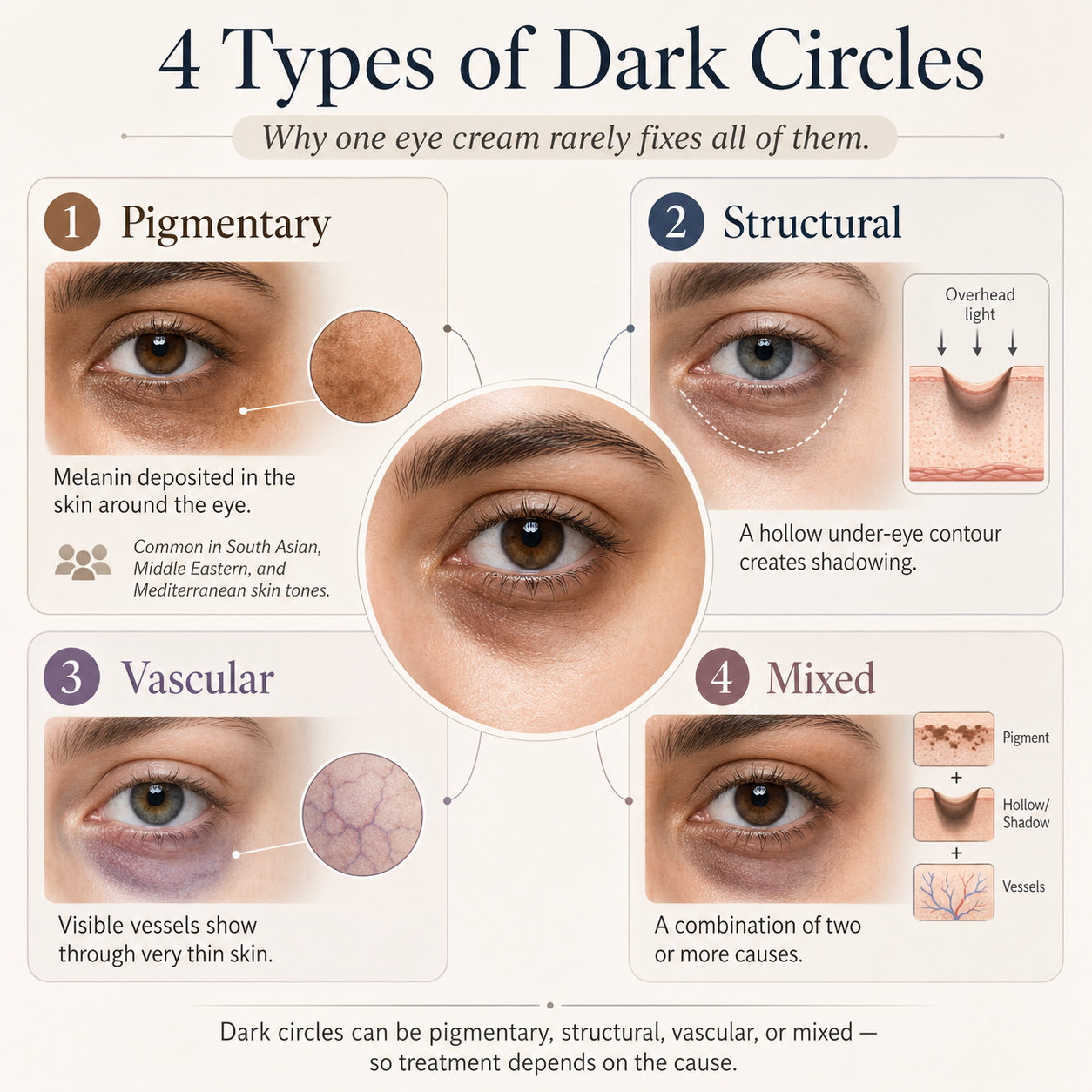
There are four different types of "dark circles". The pigmentary kind, where melanin has deposited in the skin around your eye, common on South Asian, Middle Eastern and Mediterranean faces. The structural kind, where a hollow or tear-trough creates a shadow when light hits your face from above. The vascular kind, where the blue and purple of your own blood vessels shows through skin that's as thin as tissue paper. And the mixed kind, where you've got two or three of the above in layers. A 2021 systematic review spelled this out in careful detail, and yet every eye-cream marketing page on the internet still treats dark circles like they're one problem. They're not. That's why one product almost never fixes the whole thing.
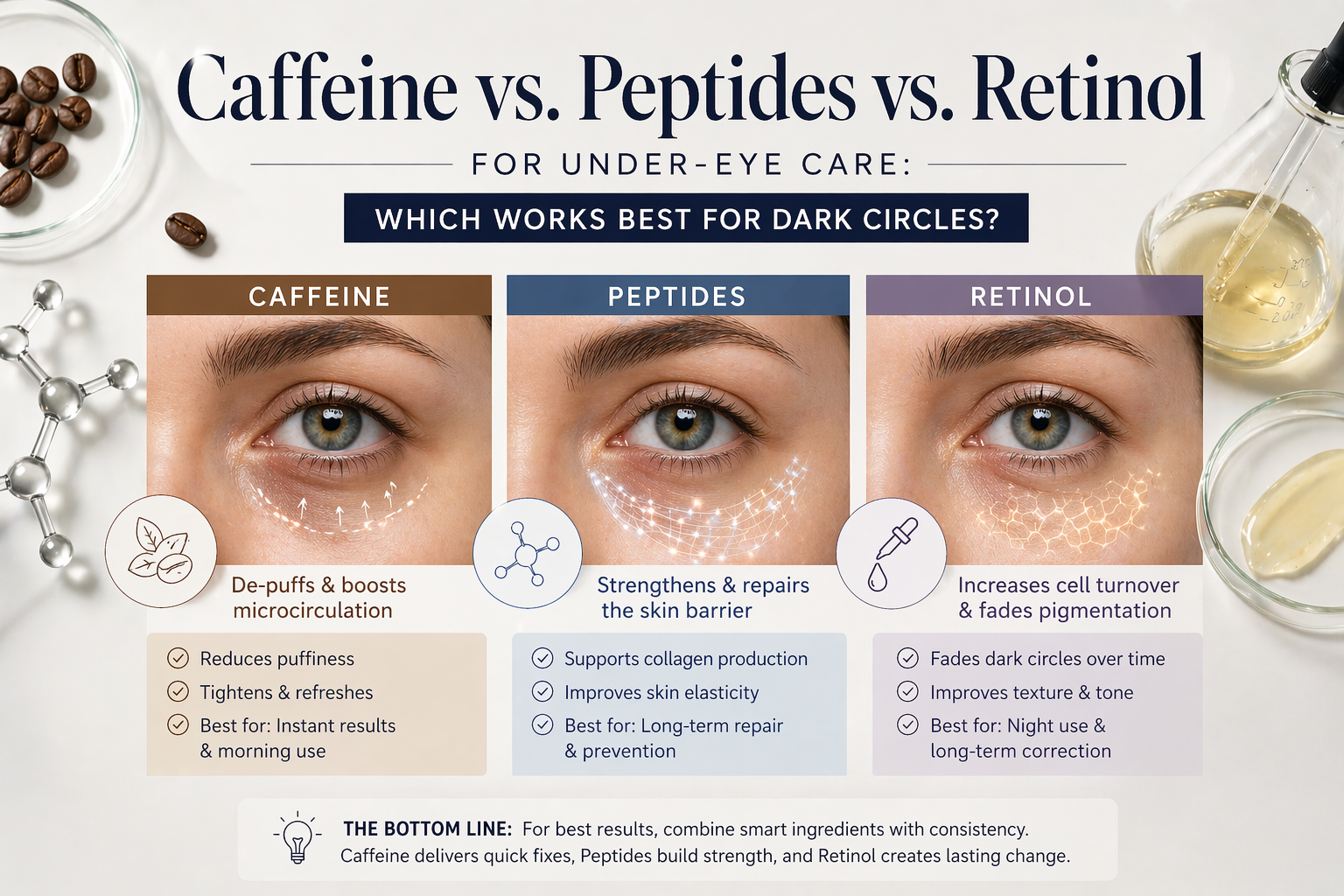
I pulled the literature so you don't have to. Below is what the research actually says about each of the three most-hyped under-eye actives, which type of dark circle each one fixes, and the four eye creams worth your money in 2026.
Disclosure: This post contains affiliate links from Amazon and various other affiliates. As an Amazon Associate, I earn from qualifying purchases. If you make a purchase through these links, I may earn a small commission at no extra cost to you.
The Four Types of Dark Circles (and How to Tell Which You Have)
Before you buy any eye cream, figure out your subtype. A cheap trick from the periorbital hyperpigmentation literature: in good natural light, lean forward and look up in a mirror.
1. Pigmentary dark circles. The darkness stays the same no matter how you tilt your head. The tint is brown or tan, not blue or purple. Pinching the skin gently shows pigment within the skin itself. Most common in South Asian, Middle Eastern, Latin and Mediterranean faces.
2. Structural dark circles. The darkness deepens when you look up and lightens when you press the area flat. It's a shadow cast by a tear-trough hollow or volume loss, not true discoloration. Tends to worsen with age and fatigue.
3. Vascular dark circles. The tint is blue, purple or pink rather than brown. The darkness is worse in the morning, better in the evening, and worse when you're dehydrated or hungover. Pulling the skin taut makes the circles more visible, not less. Most common in fair and medium skin tones, but common in all ethnicities.
4. Mixed dark circles. Some combination of the above. In plain English: this is what most people actually have, and why a single-ingredient approach so rarely works.
Caffeine: Best for Vascular and Puffy Under-Eyes
Caffeine's mechanism is short-term and vascular. When you apply it topically to the under-eye area, it temporarily constricts the small blood vessels (vasoconstriction) and reduces fluid retention.
What it does well: brightens blue or purple tint within 10 to 60 minutes, depuffs in the morning, and gives a temporary "I actually slept" look on camera. Caffeine is the only ingredient in the under-eye category with a reliable same-day visible effect.
What it does not do: it does not fade pigment, build collagen, or change the structural anatomy of the under-eye. The effect wears off within 3 to 6 hours. In plain English: caffeine is makeup-adjacent, not treatment.
Best use case: morning eye cream, before photos, or the day after a bad night. If your dark circles are worse in the morning and better by evening, caffeine is your first-line active. If your circles are the same all day, caffeine is doing less for you than you think.
Peptides: Best for Structural and Vascular Under-Eyes
Peptides work on the collagen and capillary integrity of the thin periocular skin. The two peptide complexes with the strongest research for dark circles are pal-GHK (a copper peptide that supports microcirculation and collagen) and Matrixyl (palmitoyl pentapeptide-4, which builds structural collagen). The Robinson et al. 2005 Matrixyl trial showed significant reductions in wrinkle depth and skin roughness over 12 weeks of twice-daily use — and the periorbital skin responds especially well because it's so thin that collagen gains show up faster there than on the forehead or cheek.
What peptides do well: gradually thicken the under-eye skin over 8 to 12 weeks, reducing the translucency that makes vascular dark circles visible. Peptides also strengthen capillary walls, reducing the blue tint of leaky vessels, and build the firmness that minimizes the shadow cast by mild tear-troughs.
What peptides do not do: they do not fade deep pigmentary dark circles. If your darkness is melanin-driven, peptides are a supporting active, not the solution.
Best use case: everyone, morning and night. Peptides are the lowest-risk active in the under-eye category — non-irritating, non-photosensitizing, compatible with every other ingredient. On brown skin they're especially valuable because they don't trigger the post-inflammatory hyperpigmentation that aggressive retinols sometimes do.
Retinol: Best for Pigmentary and Structural Dark Circles (and the Strongest Long-Term Option)
Retinol has the strongest clinical record of the three actives for long-term under-eye transformation, but it's also the slowest and the most irritating. It works on two mechanisms at once: it increases cell turnover, which gradually fades pigmentary deposits, and it stimulates collagen synthesis in the deeper layers, which thickens the skin and reduces translucency.
What retinol does well: fades pigmentary dark circles over 8 to 16 weeks, thickens the under-eye skin to reduce vascular visibility, smooths fine lines and crepiness around the eye, and builds real structural firmness you can see in side-by-side photos at month 4.
What retinol does not do: it does not produce same-day visible effects. It can irritate the thin under-eye skin, especially on brown skin where irritation can trigger a fresh round of post-inflammatory hyperpigmentation — the opposite of what you wanted.
Best use case: nighttime only, 2 to 3 times a week to start, building to nightly over 6 to 8 weeks. Use a retinol specifically formulated for the eye area, not a face retinol, because the eye formulations use lower concentrations in a buffered base.
Caffeine vs Peptides vs Retinol: Quick-Match Table
| Dark Circle Type | First-line active | Second-line active | Timeline |
|---|---|---|---|
| Pigmentary (brown/tan) | Retinol + niacinamide | Peptides | 12 to 16 weeks |
| Vascular (blue/purple) | Caffeine (AM) | Peptides + retinol | Hours + 12 weeks |
| Structural (shadow) | Peptides + retinol | Filler (in-office) | 12 to 24 weeks |
| Mixed (most people) | Caffeine AM, retinol PM | Peptide serum layered | 12 weeks |
The Honest Caveat
Under-eye treatment is the slowest-moving category in skincare, and no eye cream will outrun poor sleep, dehydration or unprotected sun exposure. Before you spend anything, check the three non-cream variables:
- Think: 7 to 8 hours of sleep reduces vascular dark circles more than any cream ever will.
- Think: a broad-spectrum SPF around the eyes every morning cuts pigmentary dark circle progression by roughly half, according to every systematic review on periorbital hyperpigmentation.
- Think: most dark circles are genetic, and total elimination is unlikely. A 40 to 60 percent reduction in visibility is an excellent outcome.
- Not: complete erasure. No topical matches the effect of filler or laser for structural or deep pigmentary circles.
- Not: overnight results. The fastest active (caffeine) wears off in hours. The slowest (retinol) takes 4 months to do its full work.
- Not: a reason to skip the allergy or thyroid conversation with your doctor. Chronic allergies and certain nutritional deficiencies produce dark circles that no eye cream will fix.
Top Under-Eye Products at a Glance
| Product | Best for | Key actives | Price |
|---|---|---|---|
| The Ordinary Caffeine Solution 5% + EGCG | Vascular, morning use, budget | Caffeine 5%, EGCG | $9 to $12 |
| Naturium Multi-Peptide Eye Cream | Structural, all skin tones | Matrixyl 3000, pal-GHK, caffeine | $24 to $28 |
| RoC Retinol Correxion Eye Cream | Pigmentary + structural, long-term | Retinol, glycerin, squalane | $22 to $27 |
| SkinCeuticals A.G.E. Eye Complex | Mixed, mature skin, splurge | Blueberry extract, peptides, caffeine | $108 to $120 |
The Ordinary Caffeine Solution 5% + EGCG (Best Budget Morning Pick)
This is the cheapest effective caffeine eye serum on the market. Five percent is at the upper end of clinically used caffeine concentrations, paired with EGCG (a green tea polyphenol) that adds a mild antioxidant and vasoconstrictor effect. Pat onto clean skin in the morning with your ring finger — apply before moisturizer, concealer or sunscreen.
Expect visible depuffing and a brightening of blue or purple under-eye tint within 30 to 60 minutes. For vascular dark circles, this alone can make a photographable difference. For pigmentary dark circles, you'll still need a nighttime retinol.
Naturium Multi-Peptide Eye Cream (Best Full-Spectrum Pick for All Skin Tones)
Naturium's eye cream layers four peptide complexes (Matrixyl 3000, pal-GHK copper peptides, acetyl tetrapeptide-5, and caffeine) in a single formula, which covers three of the four dark-circle subtypes at once. The texture is creamy without being heavy, the finish is makeup-friendly, and the fragrance-free base makes it safe for sensitive and reactive skin.
This is the eye cream I recommend first for brown skin. It delivers structural and vascular benefits without introducing retinol-driven irritation risk, so you can use it morning and night while you slowly build tolerance to a separate retinol eye cream. Expect visible changes at the 8 to 12 week mark.
RoC Retinol Correxion Eye Cream (Best Long-Term Pigmentary Pick)
RoC's Retinol Correxion has the longest track record of any over-the-counter retinol eye cream. It uses a stabilized retinol in a buffered, hydrating base designed specifically for the thin periocular skin. The formula is not luxurious, the packaging is basic, and the price is reasonable, which is exactly why dermatologists keep recommending it.
Apply 3 nights a week for the first month, then every other night for month two, then nightly if tolerated. Never apply directly to the lid. The ring-finger dot-and-pat technique keeps the product from migrating into the eye itself. Pair with morning peptides and caffeine for the fastest combined result.
SkinCeuticals A.G.E. Eye Complex (Best Splurge for Mature and Mixed Dark Circles)
The A.G.E. Eye Complex is the most complete formula in the splurge tier. It targets advanced glycation end-products (the browning of proteins that accelerates visible aging), delivers peptides, blueberry-derived antioxidants, and caffeine in a single luxurious cream. This is the pick for someone with mixed dark circles plus early crepey skin, or for anyone in their 40s and beyond who wants a single all-in-one eye product.
Because the active load is high, morning use only. Pair with a basic retinol eye cream at night to cover the pigmentary subtype.
The Dark Circle Protocol That Actually Works
Morning: gentle cleanse, caffeine eye cream, peptide serum (if separate from your eye cream), moisturizer, SPF 30+ around the eye area. A mineral sunscreen designed for sensitive skin is the safest pick for under-eye.
Night: gentle cleanse, peptide eye cream, retinol eye cream (alternating nights for the first month), rich moisturizer.
Weekly: one sleep mask session with a hydrating eye patch. One morning of cold spoon or jade roller work on the under-eye to manually drain lymphatic fluid.
Non-negotiable basics: 7 to 8 hours of sleep, 2 to 3 liters of water a day, consistent SPF, and a vitamin C serum or niacinamide on the face (which also helps the surrounding skin stay brighter).
Under-Eye Treatment Cost in 2026
- Drugstore tier: $9 to $27 per product (The Ordinary, RoC, CeraVe, Neutrogena).
- Mid tier: $28 to $85 per product (Naturium, Paula's Choice, Drunk Elephant, First Aid Beauty).
- Luxury tier: $90 to $280 per product (SkinCeuticals, La Mer, Lancer, Augustinus Bader).
- In-office (for structural/severe): $800 to $1,200 per syringe of hyaluronic acid filler, lasting 12 to 18 months.
For a properly stacked morning caffeine + night retinol + peptide routine, the drugstore tier gets you 85 percent of the possible result at roughly $60 total for a 3 to 4 month supply of all three products.
Frequently Asked Questions
What actually causes dark circles under my eyes?
Four different things, and most people have a combination. Pigmentary dark circles are melanin deposits, common in brown and South Asian skin. Structural dark circles are hollows or shadows cast by volume loss. Vascular dark circles are blood vessels visible through thin under-eye skin (purple or blue tint). Mixed dark circles combine two or three of the above. Each type responds to a different ingredient, which is why one eye cream rarely solves the whole problem.
Do caffeine eye creams actually work?
For vascular dark circles, yes. Caffeine temporarily constricts blood vessels and reduces fluid retention, which brightens the blue or purple tint under the eye within minutes to an hour. For pigmentary or structural circles, caffeine does almost nothing. If your circles are worse in the morning and better by evening, caffeine is likely to help.
Can peptides help under-eye dark circles?
For structural and vascular types, yes. Peptide complexes strengthen the capillary walls and build collagen in the thin periorbital skin, which helps over weeks to months. Pal-GHK (a copper peptide) specifically has data on reducing dark circle appearance through increased microcirculation. Peptides won't do much for deep pigmentary dark circles, which need a brightener.
Is retinol safe to use under the eyes?
Yes, but start low. Prescription tretinoin and cosmetic retinol both thicken the under-eye skin over 12 weeks, which reduces the translucency that makes vascular dark circles visible. Retinol also gently fades pigmentary dark circles. The risk is irritation — start with a 0.025 percent or 0.5 percent formula, apply every third night, and never drag the skin.
Which is strongest: caffeine, peptides, or retinol?
Retinol has the strongest clinical evidence for long-term under-eye transformation. Caffeine has the fastest short-term visible effect. Peptides have the best tolerance profile. For maximum effect: caffeine eye cream in the morning, retinol eye cream at night (starting 3x a week), peptide serum layered in underneath both.
Do dark circles respond differently on brown skin?
Yes. Brown skin is more prone to pigmentary dark circles because of higher melanocyte activity, plus the periocular skin is often naturally darker due to genetic factors. The 2021 systematic review on periorbital hyperpigmentation identified Indian, Middle Eastern and Mediterranean populations as most affected by the pigmentary subtype. Brown-skin protocols usually need a brightening layer (niacinamide or vitamin C) plus the retinol/peptide/caffeine stack.
How long do under-eye treatments take to work?
Caffeine: hours to a day. Peptides: 6 to 12 weeks. Retinol: 8 to 16 weeks. If you're mixing, plan on 12 weeks for visible, photograph-able improvement and 6 months for the best result.
What's the best eye cream for brown-skin dark circles?
A combination protocol outperforms any single product. Morning: caffeine plus niacinamide eye cream. Night: peptide serum layered under retinol eye cream 3x a week, building to nightly. Daily: SPF 30+ around the eye area, specifically formulated for the periocular zone.
The Science Behind These Picks
The four-subtype classification of periorbital hyperpigmentation comes from the 2021 systematic review that reorganized the dark-circle literature into pigmentary, vascular, structural and mixed categories, and established that each subtype responds to different interventions (Michelle et al., 2021, JAAD, PMID: 32740208).
The peptide efficacy data for the periocular skin comes from two landmark trials: the Wang et al. 2013 controlled study of 10 percent acetyl hexapeptide-8 on peri-orbital wrinkles, which measured 48.9 percent reduction in wrinkle depth after 4 weeks (Wang et al., 2013, Am J Clin Dermatol, PMID: 23417317), and the Robinson et al. 2005 split-face Matrixyl RCT on 93 women over 12 weeks, which demonstrated significant reductions in wrinkle depth and skin roughness (Robinson et al., 2005, Int J Cosmet Sci, PMID: 18492182). Both studies are the clinical foundation cited by modern eye-cream formulators using peptides for the periocular zone.
The Final Take
The fastest way to actually improve under-eye dark circles is to match the active to your subtype, not to buy the most expensive eye cream on the shelf. Identify your dark circle type in good light. Use caffeine if your circles are worse in the morning. Use peptides if you want slow, safe structural improvement. Use retinol at night if your circles are pigmentary or crepey, starting 3 times a week. Give the full protocol 12 weeks before judging the outcome.
My pick to start: The Ordinary Caffeine Solution 5% in the morning plus RoC Retinol Correxion Eye Cream at night for the most evidence-backed combination under $40.