If you've opened TikTok in the last six months, you've probably seen the telltale post-treatment face: tiny red dots, a Seoul dermatology clinic, and a two-week update where the skin suddenly looks filtered in real life. That's PDRN treatment. In 2026, it has quietly become one of the most requested K-beauty skin booster treatments in dermatology offices.
In the U.S., some patients are even asking for it by its less glamorous nickname: the "salmon sperm facial." Meanwhile, at-home PDRN serums and creams have exploded across every price tier, from affordable K-beauty staples to luxury skincare.
So what does PDRN actually do? Is the hype justified? And can you get meaningful results at home without paying for an in-office injectable series?
I went through the PubMed literature so you don't have to. Below is the science-backed version, the honest caveats, and the at-home routine that makes the most sense right now.
TL;DR
PDRN (polydeoxyribonucleotide) is a mixture of DNA fragments, usually derived from salmon trout, that appears to support wound healing, calm inflammation, and encourage fibroblasts to produce more collagen. In-office injections work faster and more dramatically. At-home PDRN skincare cannot fully replicate injectable Rejuran Healer or other polynucleotide treatments, but well-formulated topical products can still improve glow, texture, and recovery over 8 to 12 weeks.
If you want the short answer: clinic treatments deliver the strongest PDRN before and after results, but a smart at-home routine can still get you a visible version of the effect for much less money.
Disclosure: This post contains affiliate links from Amazon and various other affiliates. As an Amazon Associate, I earn from qualifying purchases.If you make a purchase through these links, I may earn a small commission at no extra cost to you.
What Is PDRN?
PDRN stands for polydeoxyribonucleotide. It refers to small DNA fragments, typically purified from the sperm of Oncorhynchus mykiss (rainbow trout or salmon trout). Yes, that is where the "salmon DNA skincare" label comes from.
According to articles indexed on PubMed, a 2025 review in Biomolecules proposed a more precise distinction: PDRN refers to DNA fragments under 1,500 kDa, while polynucleotides (PN) refers to longer-chain molecules often used in adjacent injectable skin booster categories (Marques et al., 2025).
Why does this matter for skin?
- PDRN appears to activate adenosine A2A receptors involved in healing and tissue repair.
- It may support the "salvage pathway," which helps cells recycle nucleotides when building new DNA.
- It seems to stimulate fibroblasts, the skin cells responsible for producing collagen, elastin, and other structural components.
A 2021 review in Pharmaceuticals described these A2A-receptor and salvage-pathway effects as central to PDRN's wound-healing potential (Galeano et al., 2021).
That is the big idea behind PDRN treatment: it does not act like filler. It encourages your skin to repair and rebuild itself, which is why the results tend to look more subtle, gradual, and natural.
Why Korea Made PDRN Famous
PDRN did not start as a beauty trend. Early work in Italy explored it for wound healing and tissue repair in the 1990s. But Korean aesthetic medicine is what turned it into a mainstream cosmetic treatment.
In Seoul, Rejuran Healer became one of the defining K-beauty injectables: not a filler, not Botox, but a regenerative skin booster designed to improve texture, elasticity, and post-procedure recovery. From there, the trend spread into Singapore, the UK, and eventually the U.S.
The timing makes sense. A 2024 systematic review covering 219 patients found that polynucleotide and PDRN injections improved wrinkles, skin texture, and elasticity, with side effects that were generally mild and temporary (Lampridou et al., 2024).
That kind of data helps explain why PDRN skin booster treatments have moved from niche K-beauty discussion boards into mainstream dermatology offices.
What PDRN Actually Does to Your Skin
Most beauty coverage stops at "skin rejuvenation." That is not very useful, so here is the more practical version.
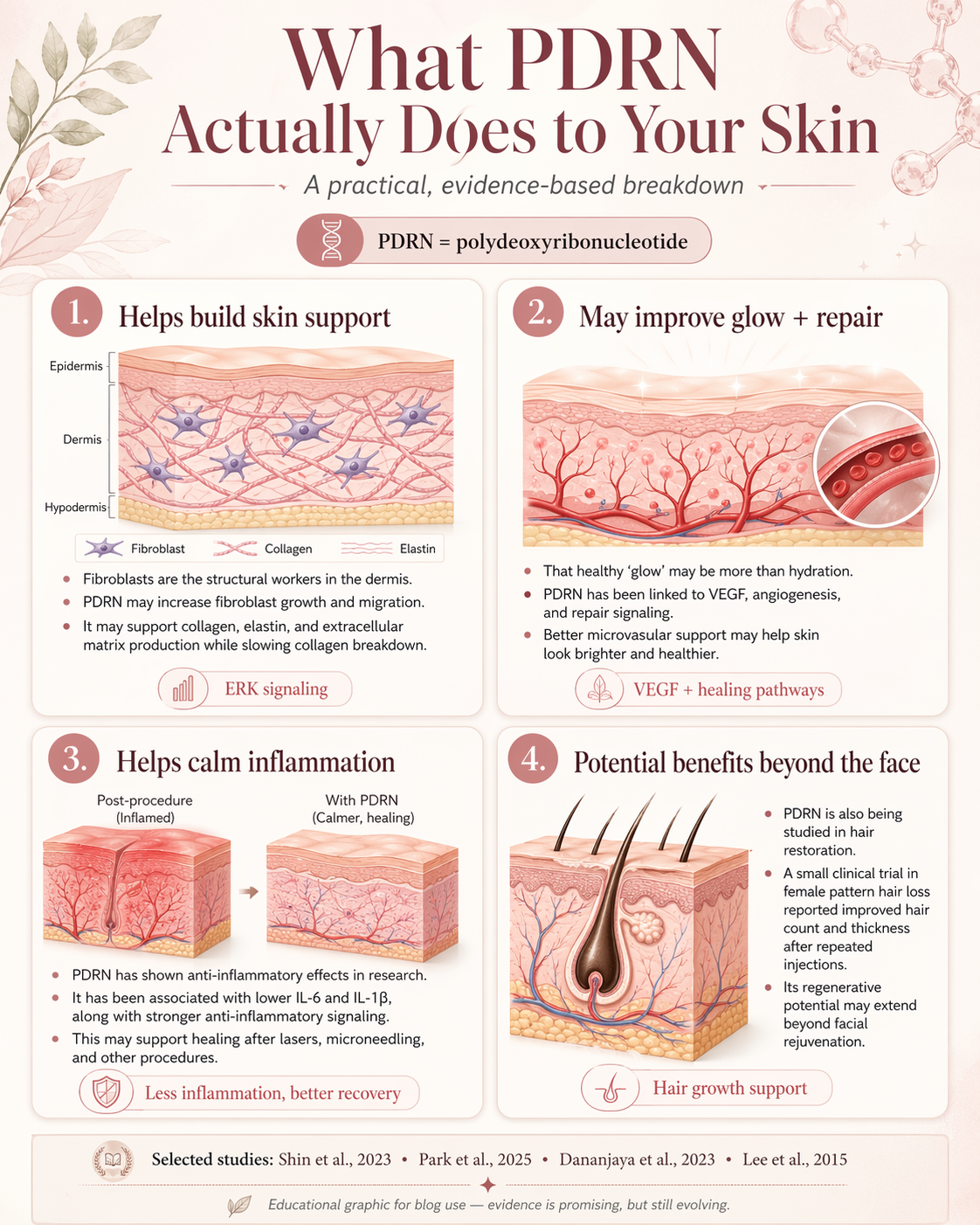
1. It may help fibroblasts build new support structure
Fibroblasts are the structural workers in your dermis. They produce collagen, elastin, and key extracellular matrix components. A 2023 paper in Molecular Medicine Reports found that PDRN increased fibroblast proliferation and migration through ERK signaling, while also affecting the enzymes involved in collagen breakdown (Shin et al., 2023).
In plain English: PDRN may help your skin build more support while slowing some of the processes that degrade it.
2. It may improve the "glow" through microcirculation and repair signaling
That dewy, healthy look people associate with Rejuran is not just surface hydration. According to a 2025 study in Archives of Dermatological Research, PDRN increased VEGF and activated multiple regeneration-related pathways tied to angiogenesis and healing (Park et al., 2025).
More repair signaling and better microvascular support may be part of why the skin can look brighter and healthier after treatment.
3. It appears to reduce inflammation and support healing
PDRN has also been studied for its anti-inflammatory effects. Research has shown reductions in pro-inflammatory cytokines such as IL-6 and IL-1β, alongside increases in anti-inflammatory signaling molecules (Dananjaya et al., 2023).
This matters because inflammation drives redness, delayed healing, and in some people, lingering pigmentation. It also helps explain why some providers use PDRN after lasers, microneedling, or other energy-based procedures.
4. It may have benefits beyond facial rejuvenation
PDRN is also being studied in hair restoration. A small 2015 clinical trial in women with female pattern hair loss reported increases in hair count and thickness after repeated PDRN injections (Lee et al., 2015).
That does not make it a miracle treatment, but it does show that PDRN's regenerative effects may extend beyond facial skin.
The Honest Caveat
This is the part many beauty posts skip: the biology is promising, but the evidence base is still developing.
A 2024 systematic review in Aesthetic Plastic Surgery looking at regenerative aesthetics, including PDRN, exosomes, and stem-cell-adjacent treatments, concluded that the category is promising but still ahead of the strongest long-term evidence in some areas (Rahman et al., 2024).
That does not mean PDRN treatment is fake. It means your expectations should stay grounded. Think:
- better texture
- better radiance
- modest improvement in fine lines and elasticity
- faster-looking recovery after procedures
Not:
- instant skin replacement
- filler-level volume
- dramatic age reversal in one session
In-Office PDRN Treatment: What to Expect
If you are considering an injectable polynucleotide treatment such as Rejuran Healer, the typical protocol is 3 to 4 sessions spaced about 2 to 4 weeks apart.
During treatment, a provider places multiple small injections across the face, neck, under-eye area, or scalp. Most clinics use numbing cream first. Afterward, you can expect swelling, visible injection points, and redness for a few days. Many people start to notice more obvious results around weeks 2 to 3.
Brands you'll hear about:
- Rejuran Healer / Rejuran i / Rejuran S — the best-known Korean option
- Plinest — an Italian PDRN product seen more often in Europe
- Nucleofill — a common name in UK aesthetic clinics
- aiva Re-Verse — a newer combination approach involving PDRN with other injectable biostimulators; a small 2025 case report showed strong improvement in all three patients studied (Chaudhry, 2025)
PDRN cost in 2026
In a U.S. clinic, PDRN treatment cost in 2026 is typically around $400 to $900 per session, with a full treatment series often landing between $1,500 and $3,500.
That is one reason interest in PDRN at home has risen so quickly.
Can You Get PDRN Results at Home?
This is the question that matters most for most readers.
Topical PDRN will not match injection results. The skin barrier is good at keeping large molecules out, and even low-molecular-weight formulas are working under very different conditions than an injectable placed directly into tissue.
Still, newer Korean products are trying to close the gap by using:
- low-molecular-weight PDRN
- liposomal delivery systems
- microneedle or "reedle" formats
- support ingredients such as peptides, niacinamide, centella, and humectants
So while PDRN at home is not equivalent to Rejuran treatment, it can still be worthwhile if your goal is gradual improvement in glow, barrier support, and texture.
The At-Home PDRN Routine That Makes Sense
If I were building a topical PDRN skincare routine right now, I would keep it simple and consistent.
A note on the links below: I've routed each product to the network with the highest creator commission for that brand (LTK typically pays 8–15% on K-beauty vs. Amazon's ~3% on the Beauty category). Amazon links use my tag beautybop-20 — they work immediately. LTK links go to my shop.Step 1: Use one core PDRN serum morning and night
This is the foundation. Look for a formula that clearly positions PDRN, salmon DNA, or polynucleotide technology as a core feature rather than a throwaway marketing ingredient.
Current picks:
- VT Cica Hyalon PDRN Serum — a more affordable option that pairs PDRN with centella for skin that feels irritated, post-acne, or easily sensitized.
- 👉 Shop on Ulta
- Or on Amazon: VT Cica Hyalon PDRN Serum
- Rejuran Turnover Ampoule — probably the most credible cosmetic extension of the Rejuran name.
- 👉 Shop on Sephora
- Or on Amazon: Rejuran Turnover Ampoule
- MEDICUBE PDRN Pink One Shot Collagen Serum — a beginner-friendly serum layered with collagen-supportive actives.
- 👉 Shop on Stylevana
- Or on Amazon: MEDICUBE PDRN Pink One Shot
- Numbuzin No.5 Vitamin-Niacinamide Concentrated Serum — not a pure PDRN serum, but a strong companion product if tone and pigmentation are part of your goal.
- 👉 Shop on Stylevana
- Or on Amazon: Numbuzin No.5 Vitamin-Niacinamide Serum
Step 2: Add microneedle or reedle-style treatments 2 to 3 times a week
This is where a lot of the at-home strategy becomes more interesting. Microneedle-style products can help bridge part of the absorption problem.
- VT Reedle Shot 100 / 300 / 700 — start at 100 if your skin is sensitive; 700 is aggressive.
- 👉 Shop on Nordstrom
- Or on Amazon: VT Reedle Shot 100
- Mixsoon Centella patches — a calming, barrier-friendly option for recovery nights between Reedle sessions.
- 👉 Shop on Walmart
- Or on Amazon: Mixsoon Centella Patches
If your skin is reactive, start at the lower-intensity end and go slowly.
Step 3: Support the routine with a barrier-friendly moisturizer
PDRN works best in a routine that also supports hydration and recovery.
- Beauty of Joseon Revive Serum
- 👉 Shop on Sephora
- Or on Amazon: Beauty of Joseon Revive Serum
- COSRX Advanced Snail 92 All-in-One Cream
- 👉 Shop on Ulta
- Or on Amazon: COXRX Advanced Snail 92 All-in-One Cream
Step 4: Wear sunscreen every day
If your goal is collagen support, smoother texture, or fading the look of post-inflammatory marks, SPF is not optional. UV exposure breaks down collagen and can easily cancel out the progress you are trying to make.
If you have melanin-rich skin and are prone to hyperpigmentation, a sunscreen with iron oxides may be especially helpful because visible light can worsen melasma and PIH.
Your shortlist:
- Beauty of Joseon Relief Sun: Rice + Probiotics SPF 50+
- 👉 Shop on Walmart
- Or on Amazon: Beauty of Joseon Relief Sun SPF 50+
- Isntree Hyaluronic Acid Watery Sun Gel SPF 50+
- 👉 Shop on Target
- Or on Amazon: Isntree Hyaluronic Acid Watery Sun Gel
A Note for Brown, Black, and Melanin-Rich Skin
Most PDRN treatment coverage is written with either East Asian or white skin in mind. But for readers with brown, Black, South Asian, Latina, Middle Eastern, or otherwise melanin-rich skin, two points matter more:
1. PDRN's anti-inflammatory profile may be especially relevant for PIH-prone skin. If your skin tends to turn any irritation into lingering pigmentation, then inflammation control matters. PDRN is not a pigment-corrector by itself, but its anti-inflammatory role may help reduce the intensity or duration of the inflammatory window that contributes to post-inflammatory hyperpigmentation.
2. Provider selection matters more if you're doing injections. If you are considering in-office PDRN skin booster treatments, ask whether the injector has real experience with Fitzpatrick IV to VI skin. Needle trauma, bruising, and post-procedure pigmentation do not show up the same way on melanin-rich skin as they do in many glossy clinic marketing photos.
Ask to see before-and-after photos on patients who actually look like you.
PDRN Treatment FAQ
How long does topical PDRN take to work? Most people should think in terms of 6 to 8 weeks for texture and 10 to 12 weeks for more visible improvement in fine lines or overall smoothness. With topicals, consistency matters more than expecting overnight change.
Is PDRN vegan? Usually no. Most currently marketed PDRN is salmon-derived. A 2025 paper suggested that microalgae-derived PDRN may eventually become a real alternative, but it is not yet widely available in consumer skincare (Park et al., 2025).
Can I use PDRN with retinol? Yes. Many people actually like pairing them because PDRN may help offset some irritation. A simple approach is to apply PDRN first, let it settle, and follow with your retinoid.
Can I use PDRN while pregnant or breastfeeding? Topical products may be lower risk than injections, but pregnancy and breastfeeding are not the time to guess. Skip injectable treatments and clear new skincare products with your doctor or OB first.
Is the "salmon sperm facial" nickname accurate? Crude, but yes. It usually refers to purified salmon-derived DNA used in PDRN treatment.
Does PDRN help acne scars? It appears most promising for texture-related concerns such as rolling or boxcar scars, especially when combined with procedures like microneedling or laser. Ice-pick scars are usually harder to shift with topical skincare alone.
The Bottom Line
PDRN treatment is one of the more interesting regenerative trends in aesthetics because there is real biology behind the hype. Injectable treatments such as Rejuran Healer offer the strongest results. At-home PDRN skincare is not the same thing, but it can still be a smart option if you want a more affordable route to better glow, smoother texture, and stronger-looking skin over time.
If I were starting from zero, I would buy one good PDRN serum, one microneedle-style support product, and one excellent sunscreen. Then I would commit to 12 weeks and take photos in the same flat lighting on Day 0, Day 30, Day 60, and Day 90.
That is the easiest way to tell whether your routine is actually working.
References
- Marques C. et al. From Polydeoxyribonucleotides (PDRNs) to Polynucleotides (PNs). Biomolecules, 2025. DOI: 10.3390/biom15010148
- Lampridou S. et al. The Effectiveness of Polynucleotides in Esthetic Medicine: A Systematic Review. J Cosmet Dermatol, 2024. DOI: 10.1111/jocd.16721
- Galeano M. et al. Polydeoxyribonucleotide: A Promising Biological Platform to Accelerate Impaired Skin Wound Healing. Pharmaceuticals, 2021. DOI: 10.3390/ph14111103
- Shin S.M. et al. Polydeoxyribonucleotide exerts opposing effects on ERK activity in human skin keratinocytes and fibroblasts. Mol Med Rep, 2023. DOI: 10.3892/mmr.2023.13035
- Park J.M. et al. Effects of Chlorella protothecoides-derived polydeoxyribonucleotides on skin regeneration and wound healing. Arch Dermatol Res, 2025. DOI: 10.1007/s00403-025-03885-w
- Yu M. & Lee J.Y. Polydeoxyribonucleotide improves wound healing of fractional laser resurfacing in rat model. J Cosmet Laser Ther, 2016. DOI: 10.1080/14764172.2016.1247966
- Lee S.H. et al. Therapeutic efficacy of autologous platelet-rich plasma and polydeoxyribonucleotide on female pattern hair loss. Wound Repair Regen, 2015. DOI: 10.1111/wrr.12250
- Rahman E. et al. Regenerative Aesthetics: A Genuine Frontier or Just a Facet of Regenerative Medicine: A Systematic Review. Aesthetic Plast Surg, 2024. DOI: 10.1007/s00266-024-04287-5
- Dananjaya S.H.S. et al. Multifunctional alginate/polydeoxyribonucleotide hydrogels for promoting diabetic wound healing. Int J Biol Macromol, 2023. DOI: 10.1016/j.ijbiomac.2023.128367
- Chaudhry M. First Reported Use of aiva® Re-Verse, a Novel Combination Injection Protocol for Facial Rejuvenation. Cureus, 2025. DOI: 10.7759/cureus.89664
Keywords: PDRN treatment, PDRN skin booster, Rejuran Healer, K-beauty injectable, polydeoxyribonucleotide, salmon DNA skincare, best PDRN serum, PDRN at home, Rejuran alternative, PDRN for brown skin, PDRN vs filler, PDRN before and after, PDRN cost 2026, Korean skin booster, polynucleotide treatment, VT Reedle Shot review, MEDICUBE PDRN review